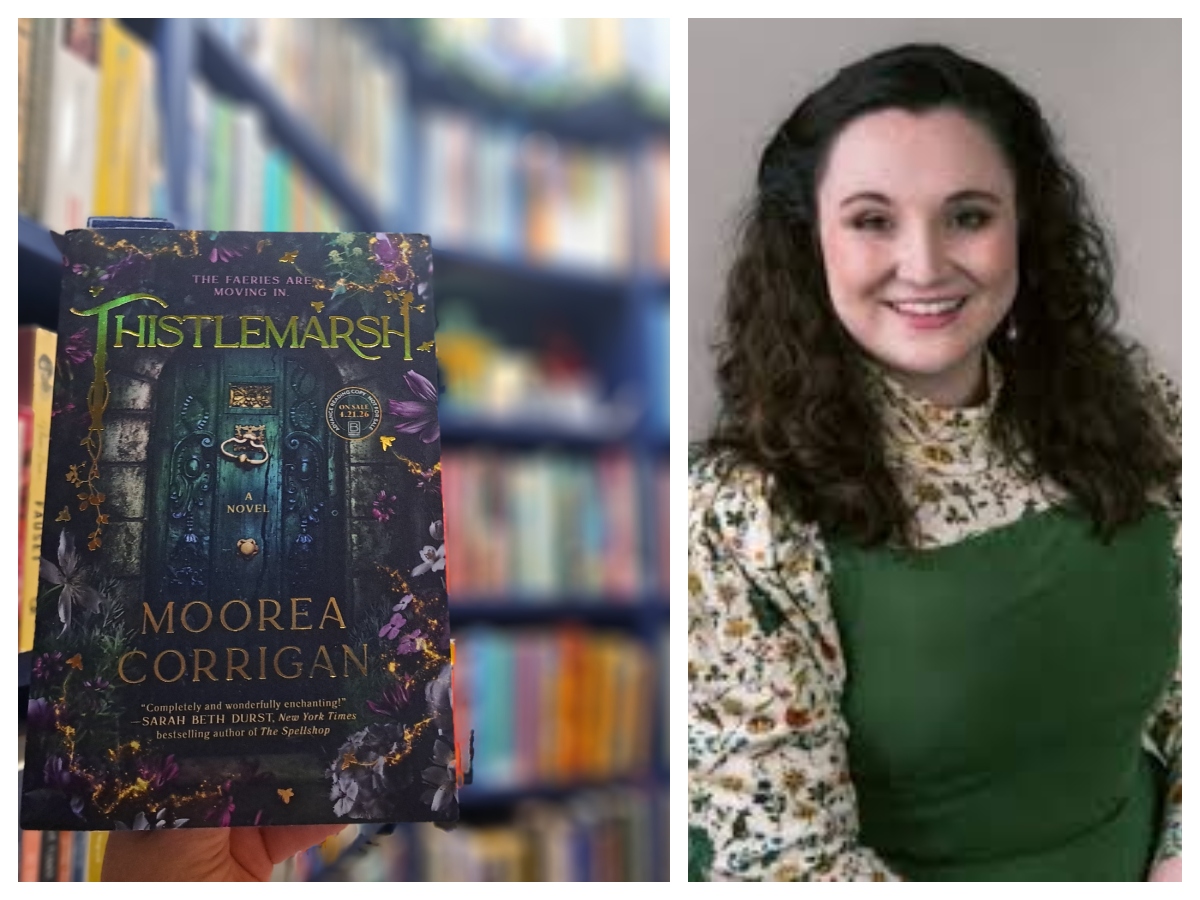
Thistlemarsh is the last place that Mouse wants to be right now. Mouse has had a patchwork quilt of a life. Her mother, once the daughter of a great house who married a gardner, died when she was very young. She was left alone in London with her father, and her brother Roger, who was immediately sent off to live with the statuesque Uncle-Lord-Dewhurst and marvelous cousin Bertie. Her mother’s birthplace of Thistlemarsh Hall, next to the village of Tithe, on the side of the winding trains that snake through the British landscape would become home to Mouse and her Father a few years later, just shortly before her father died.
Mouse was not beloved by her Uncle, or by his staff, but her suffering was also not great. She lived on the edges of a life, supported by the wonderful Roger and Bertie. Then came the Great War, and Bertie was taken from them, while Roger remained, but as a mere shell of himself. When they were injured Mouse herself followed them to war as a nurse and shocked everyone, including herself, by her capabilities. When Uncle-Lord-Dewhurst dies and leaves Thistlemarsh Hall and all his property to Mouse, everyone is surprised. But then come the conditions attached to the bequest, conditions to be met within 30 days, and no one is shocked anymore.
But here’s the thing, Thistlemarsh Hall was once a Faerie-blessed house, a connecting property between the land of men and the Fae where the family was blessed and the Fae King received a tithe. In a wild trick between the Fae King and the Dewhursts years before, neither came out victorious and all have suffered since. While faeries have not been seen in England for over a hundred years, Mouse has always been fascinated by them, a curiosity inherited from her mother.
In a very Whovian moment involving a statue that you really shouldn’t take your eyes off, Mouse encounters Thornwood, a Fae, and his servant Mickelthwaite, who is… something else. Having long been warned of the dangers of Faeries and their deals, she makes a deal with him to help her restore Thistlmarsh within the 30 days specified within the will. But neither gets what they bargained for, and of course Thornwood is much more than he appears.
Thistlemarsh is a rich tapestry of post war Britain and post Fae Britain. I spent a semester in my youth studying post war literature, and Corrigan captures some of the loss and the stagnation of power ever present in the literature and poetry that prevailed between the wars. While walking around Thistlemarsh Hall, one might be forgiven for thinking of Ishiguro’s Darlington Hall, while Bertie and Roger give off a sense of Waugh’s Charles and Sebastian. The sense of what has been lost is ever present in the text, the loss of physical person, the loss of self, the loss of a sense of place that once defined you.
Thornwood and Mouse go through a series of “tests” or tricks as they seek to restore the house, and when the last test is passed, the last knot unravelled, the story takes a wild unforeseen turn. Certainly the last act of the book is the kind that you simply do not put down simply because it is 2am and you have work in the morning. The narrative switch that Corrigan accomplishes as the tale unravels is fast paced, and compulsive. Almost as if you have been tricked into non stop reading by some kind of other worldly entity.
Corrigan manages to avoid the trappings of trope in the wealth of Fae literature that abounds at the moment, by having their absence and reappearance played out through Mouse’s gaze, which manages to be both simple and piercing at the same time. And so Mouse, armed with her mother’s book, encounters a fae myth and finds out it is real, encounters a Fae myth and it crumbles at her fingertips. She also manages to teach the Fae something about himself through the telling of human stories about them. Reminiscent of the beloved footnotes of Jonathan Strange & Mr Norrell Corrigan uses references to the book, “Lady Blakeney’s Tales of Faerie Stories for the Modern Traveler” collected by Lady Blakeney of London, England, with consultation by Lord Threadneedle of Raven Tower, Fairie, 1780”, throughout to tie together what Mouse is seeing versus the stories she has been told throughout her life. Corrigan puts great faith in her reader, and uses the book to explain the unraveling and re-imagining of myth instead of simply explaining it to us. In such ways we are invited to be co-creators with Mouse of a new understanding of the Fae. Thornwood traveling to London creates a scenario that I haven’t encountered before, and I am obsessed.
Aside from Mouse and Thornwood, there is a cast of peripheral characters that leave you wanting more. The Butler left the story far too soon, Mickelthwaite needs his own book, and the vicar is the thing that PBS dreams are made of. Then there is the house. The novel could very well have started with the opening line “Last night I dreamt I went to Thistlemarsh again” for the way the house plays into the stories of both Mouse and Thornwood, and for its active presence as a character in the novel. Mouse’s room alone is worth exploring. This is definitely a Fae deal worth making.
Thistlemarsh is available on April 21 wherever books are sold. GeekMom received a copy of this book for review purposes, all Fae obsessions are our own.