

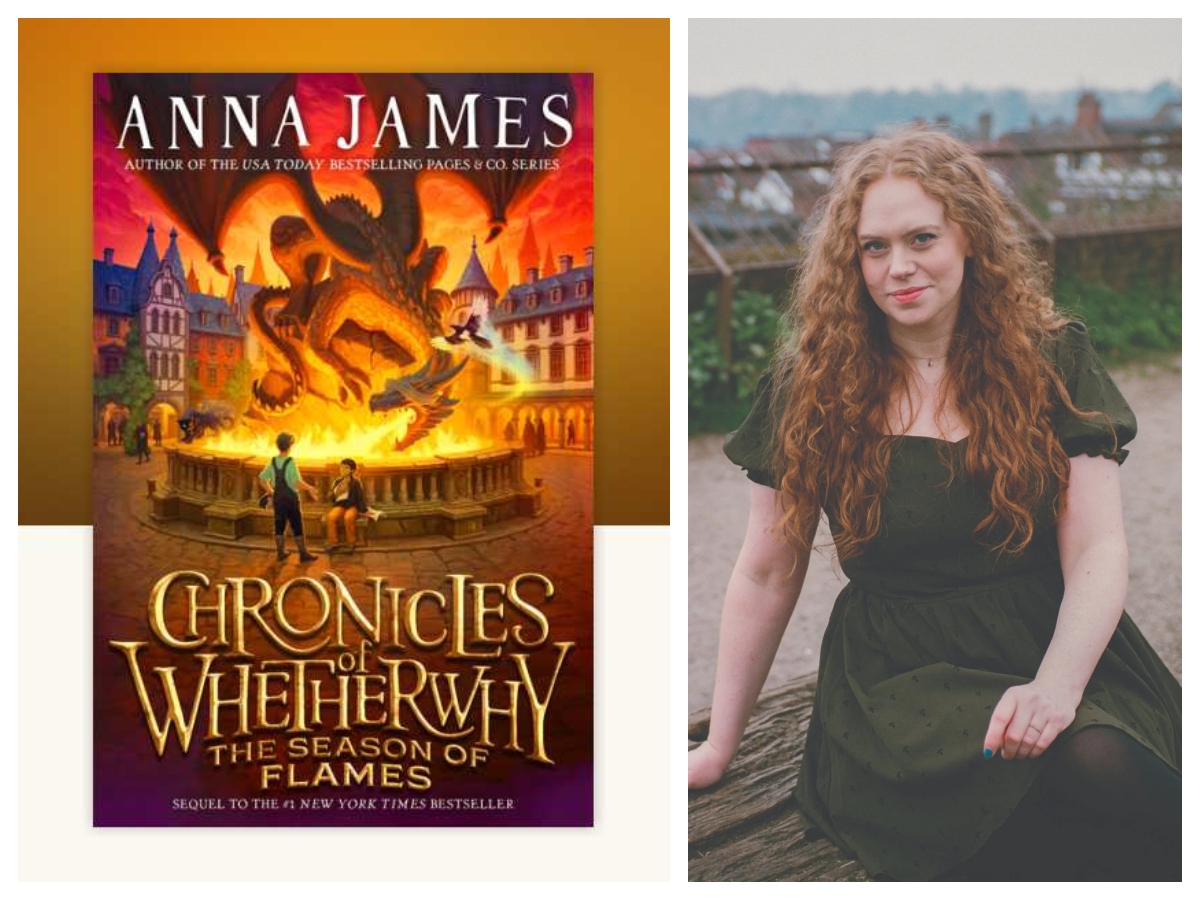
The Season of Flames is the second book in Anna James’s middle-grade fantasy series The Chronicles of Whetherwhy. We continue the exploration of magic, systems of power and how to challenge them, and the bonds of both biological and found family.
The second installment of The Chronicles of Whetherwhy however does not pick up where we left off. We are not swiftly thrown back into the lives of Juniper and Rafferty. And that may be one of the most rewarding things about this series, and certainly about the author herself.
Anna James has a spectacular sense of time.
Not only is the second Chronicle of Whetherwhy not set immediately after the first but it is set a whole lifetime of fifteen years later. James then artfully and realistically approaches the passage of time for the former characters we do encounter. They do not all magically know what has been happening to each other, or in other towns, or even at Court. They know their own story, but they do not know what happened to those who left the first Chronicle and actually left their lives in the timeline. James also doesn’t destroy the flow of this story with interruptive backstory and exposition, but lets things come out naturally through conversation, side quests, and in outright explanation only when it is actually necessary to the current story. Just as the characters don’t know what has been happening elsewhere, we walk into some of their lives over a decade later and are given no cute or unnecessary summations. James does not simply pose explanations because it makes it easier to get from the first book to the second. She weaves her story through time with such absolute mastery, that she really should be writing episodes of Doctor Who. We are given the information we need, when we need it, but it is done flawlessly. I don’t know when she plans to set the third installment, but there is sheer magic in how this quartet is coming together.
The Chronicles of Whetherwhy are structured in the same way as the 1987 film The Princess Bride, in that we are presented with a grandfather reading a story to his grandchildren. The narrative is infrequently interrupted with commentary from the gaggle of grandchildren. Again, much as with the treatment of time, this does not feel like an interuption but is woven into the fabric of the story itself. In fact in this second installment you really get the sense that the telling of the story is a much bigger part of the tale itself than it would first appear. I have my suspicions as to the identity of the grandfather, but I did change my mind several times while reading The Season of Flames so I myself am not a reliable narrator.
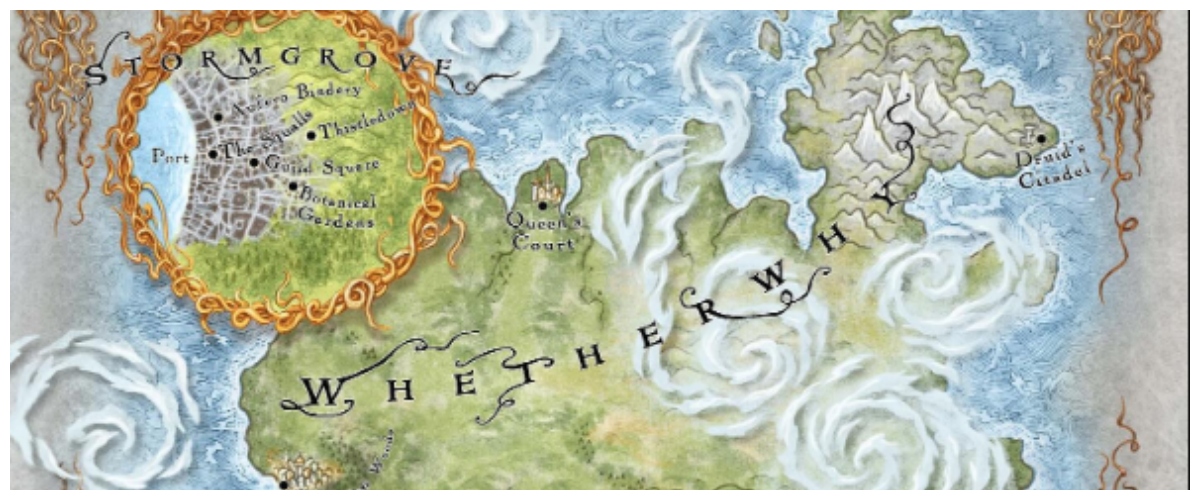
We join Elio and his father on the road with the circus they have been traveling with for Elio’s entire life. Under ringmaster, and enchanter, Stella, they have traveled much of the land of Whetherwhy, steering clear of rival circuses and the Royal Court. Events leading them closer to the Queen however, force them into the paths of old antagonists and send Elio and new friend Pom (short for Pomegranate) on a magical race across the land and back again in search of answers. What is Oleander Young doing at court? What happened to Elio’s mother? What actually is the source of all magic and enchantment in Whetherwhy? Some questions run deeper than others, but the series is called The Chronicles of Whetherwhy and in The Season of Flames we begin to see more clearly the scope of the universe that James is building.
James is not only adept at world building but is responsible with her characters. That is not to say she is responsible and strict, therefore following all rules, is boring, or mundane. Her writing is anything but mundane. She is passionate about people treating each other well, and commits the characters on the right side of the story to pursuing that fiercely. Much like the old adage about telling the truth because it is the easiest thing to remember.
“That’s very kind,” said Pom, pink-cheeked with pleasure.
“Kind is generally the best way to be,” said Eucalyptus.
“Even if you hide it a little bit behind fiery dragon fountains and creeping around in the shadows,”
James is whole heartedly committed to whole hearted characters. When faced with a brutal decision, the morally grey does not mount much of an argument before being shut down by balance, reason, and empathy.
“I was not going to let you do it like that,” said Juniper quietly. “We will find another way. There is always another way.”
You cannot read this and not help thinking of the many debates over the years about an elderly magician permitting a tiny boy to be the first and last line of defense in an epic battle with evil. There is always another way, unless you only want to take the one that is easiest for you personally. I may use this line in some political battles in real life.

We spend much less time at Thistledown Academy in this second book, which brings us well out of the realm of books about magical schools. The school and it’s principal are key, but they are side characters at best. Far more interesting is the development of the history of enchantment, and the way that the stories we tell weave together with the facts to develop our reality.
While we do not spend much time in school in this book, we do spend time learning a little more about the different types of magic, and even more about those giftings that are magical in origin but not in expression such as Elio’s affinity for animals, or Pom’s gift for storytelling. While it would be easy to say that Enchanters are the best and everyone else is sub par, which seems to be the Queen’s feeling, James again reinforces that everyone’s gift has a purpose and a place. In the first book this played out in the very divisive feelings that can occur when your twin is an enchanter and you are not. Is this fair? Are they better? In The Season of Flames we explore the deeper idea at play and realize that this is not just a conversation that the twins had, but that everyone else has too. And yet James continues her commitment to kindness in providing us with examples of wonderful characters who are not Enchanters. Yes, Enchanters are useful, but they aren’t definitively better than everyone else. Indeed Pom’s skill with story telling saves them just as often as Juniper’s enchanting skills. The world being discussed is magical, but these are lessons that would be well learned and applied in our own non magical world.
Chronicles of Whetherwhy, The Season of Flames was written by Anna James and is released this week everywhere that books are sold. Anna James is a #1 New York Times bestselling author of children’s fantasy books including the Pages & Co series, the Chronicles of Whetherwhy, and Alice With a Why. Her debut adult novel Read Me Like a Book, will be published in spring 2027. GeekMom received a copy of this book for review purposes.


