
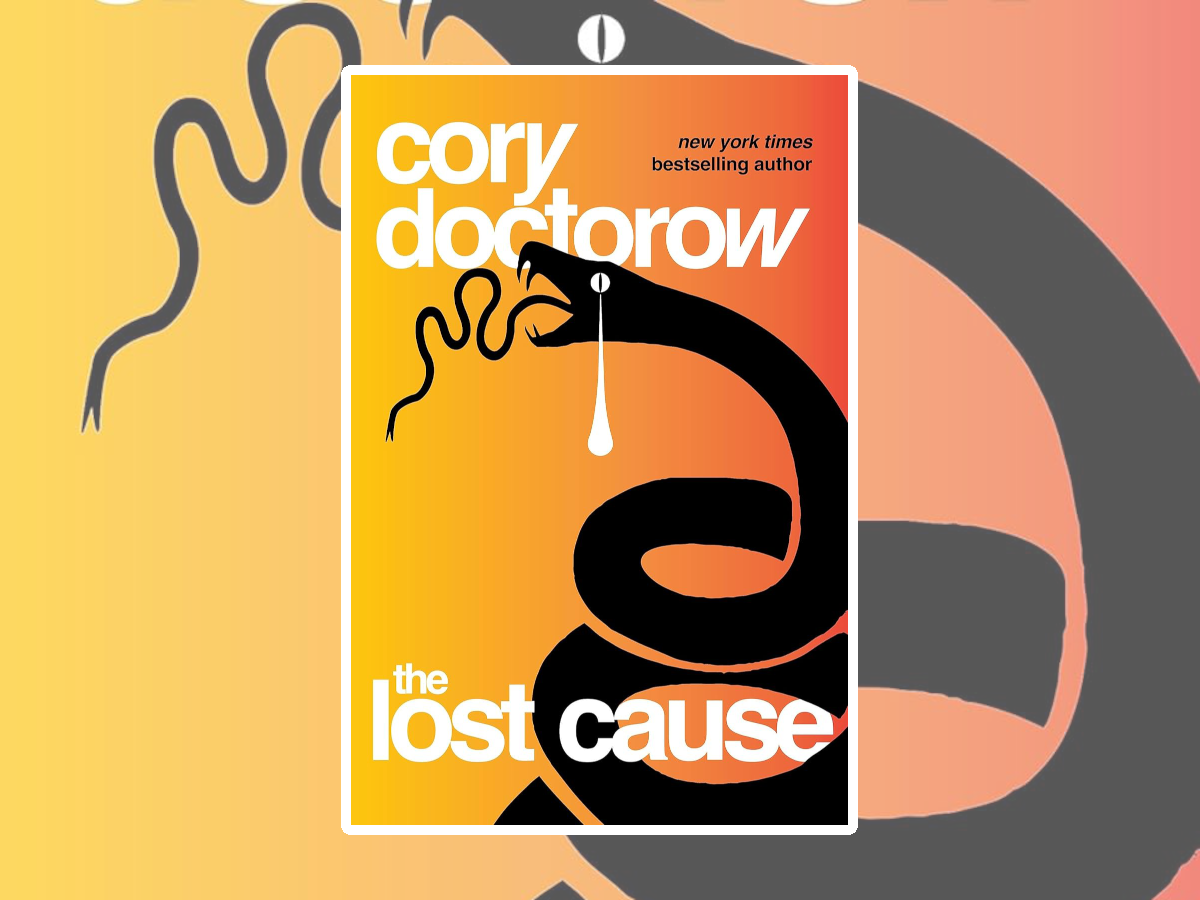

I have been a big fan of Cory Doctorow novels ever since reading Little Brother some 15 years ago. I’ve reviewed a couple of his more recent novels on GeekDad. Doctorow has his finger on the pulse of technology; how it is evolving, how it can be harnessed, as well as how it can be abused. He brings all this to bear in his latest novel, ‘The Lost Cause,’ a near-future examination of climate catastrophe and how technology can bring us back from the edge.
What Is The Lost Cause?
The novel is set in Burbank, California, some 30 years from now. Climate change has ravaged the US and the rest of the globe. There are countless displaced people looking for somewhere to live.
Workflow has changed in the intervening 30 years into what has become a flexible, more ethical, gig economy. As the novel opens, Brooks takes the call for a job. He needs to check a security camera on a solar panel installation. When he arrives, he discovers it’s not a malfunctioning sensor but an attempted terrorist attack.
During a heated and threatening discussion, Brooks realises he knows this wannabe climate martyr. He’s a friend of his grandfather. This sets up the two opposing forces of The Lost Cause. The younger, outward looking, generation and an older “post-MAGA” crowd, who want everything to stay the same. Just one of the many lost causes in the book. Throughout the rest of the novel, these two factions are in opposition to one another, making the story forever pregnant with the possibility of a Jan 6th type uprising.
Alongside that, is a story of how like-minded people, working together, whilst harnessing modern technology may be able to overcome one of the world’s greatest challenges. The Lost Cause is also a reminder how difficult the recovery is likely to be.
Why Read The Lost Cause?
Whilst there are a number of reasons to read The Lost Cause, this isn’t Doctorow’s strongest novel and if you’re new to his work, I wouldn’t start here. Start with Little Brother.
As ever, Doctorow offers a fascinating insight into how life might work, if its leaders had a different mindset. The book outlines the “Green New Deal,” which is essentially an extension of Joe Biden’s Inflation Reduction Act. In the book, a future, progressive, President has put the Green New Deal in place to help promote green jobs and sustainable living. It’s interesting to imagine how this new economy might work, especially in conjunction with new technology and altruistic social media communities.
There is push back, both from the older generation (which is my generation) and from corporations, who want to make a lot of money; Libertarianism is still alive and well in Doctorow’s future. Whilst this picture of the future is bleak, the novel’s solutions felt too Utopian to me. It suggests we’ll be relying an awful lot on high-tech communes working together in perfect harmony.
Yes, there is hope in technology, but the “everyone will pitch in for the good of mankind” mentality found in The Lost Cause, felt pollyannaish to me. The novel is very “us and them,” and I think reality is more nuanced than that. Perhaps my irritation at the Utopian ideals of the younger characters, stems from the fact I will be 80 year old, come the time the novel is set. Perhaps Doctorow is telling me it’s time to stand back and let the youth run things. (As a counterpoint, to my argument of lack of nuance, Brooks and another activist in the novel, do hold conflicting opinions on the best way forward, and argue about it, so perhaps I’m being unfair.)
This is a novel of ideas but ideas can’t drive novels alone. Characterization is thin in The Lost Cause. I forgot that central character’s name, even though he’s called Brooks, which is my surname. The protagonists of the novel feel like vehicles for ideas rather than well-rounded human beings.
In black and white, this assessment looks rather negative. The Lost Cause is, after all, a novel about ideas. Its purpose is to propose alternative solutions to a desperate problem. Characterization is secondary to the novel’s central thrust. Can we pull ourselves back from the brink, or are we a lost cause? Doctorow’s work is valuable because of his ability to bring modern ways of thinking and implementing technology into the light. He helps those of us stuck in the last century realize what is possible.
Reading Docotorow novels always leaves me feeling old and out of my depth. Yet, he also opens up my eyes to the possiblities and pitfalls of technology I had no idea existed. He’s an excellent communicator of what is possible and we need voices like his, if we going to avoid being sucked into an abyss ruled by corporate overlords.
So, whilst I didn’t 100% enjoy this novel, I found myself glad that I read it. I consider myself an easy-going progressive sort of guy, but then perhaps that is because my world view is rarely challenged. Doctorow has done that and I’ve reacted negatively. Perhaps I’m more reactionary than I’d care to it admit. Perhaps in 30 years, I’ll be a solar powered sabateur myself.
I hope not and keeping on reading books like The Lost Cause can only help me avoid the pitfalls of believing my own infallibility.
If you would like to pick up a copy of The Lost Cause you can do so here, in the US, and here, in the UK. (Affiliate Links)
If you enjoyed this review, check out my other book reviews, here.
I received a copy of this book in order to write this review.
Click through to read all of “‘The Lost Cause’ by Cory Doctorow: A Book Review” at GeekDad.If you value content from GeekDad, please support us via Patreon or use this link to shop at Amazon. Thanks!


