The 2022 Be the Artist series celebrates the art of “toons” and similar fun styles.
Tim Burton’s filmmaking expertise is the reason many know about his work on the big screen, and his first feature film venture was when he was asked by Pee-Wee Herman (Paul Reubens) to direct his film, Pee-Wee’s Big Adventure. Burton was 25 at the time, but the film was such a huge hit that it helped get him noticed. More than 35 years later, Burton’s films from Beetlejuice to Batman to Frankenweenie and beyond are worldwide favorites. He is also behind several short films, some music videos, and soon his first live-action television series, Wednesday, based on the life of Wednesday Addams.
Yet, it is his completely unique and magically macabre style that permeates in all his works that makes his artistic style worthy of its own coined phrase, “Burtonesque.”
Those who see him primarily as a director need to remember that his history in animation and visual arts helped him to make his mark. Burton was born in 1958 in Burbank, California, and spent his childhood and teen years there. He was able to attend California Institute for the Arts (aka CalArts) not long after it opened in the Character Animation Program. His work was so distinct that he landed an apprenticeship with Walt Disney Productions. From 1982 to 1984, he created three short films, including two highlighting his stop-motion animation expertise. The other was a live-action short of Frankenweenie, long before his feature-length stop-motion remake.
His standout, Vincent, gained him his first chance to work with his own artistic hero, Vincent Price:
His filmmaking landed him several awards and honors, but he always kept his love of visual arts. According to his own website, Tim Burton.com, “Burton expressed himself through drawing, painting, and photography, all of which have become an integral part of his creative process which he continues to pursue to this day.”
His illustrations and style are so distinct that exhibits showcasing his prints, original illustrations and paints, stop-motion animation figures, and movie props, such as the currently touring The World of Tim Burton and The Lurid Beauty of Monsters, have drawn thousands of visitors worldwide.
Burton has always understood no matter the subject or type of project, the important thing is to remain true to yourself as an artist.
This often-cited anecdote attributed to Burton conveys this attitude well: “Don’t worry about how you ‘should’ draw it. Just draw it the way you see it.”
Tim Burton is able to turn simple, sketchy drawings into endless, imaginative, and macabre worlds, and he didn’t even need to have expensive art supplies to do that.
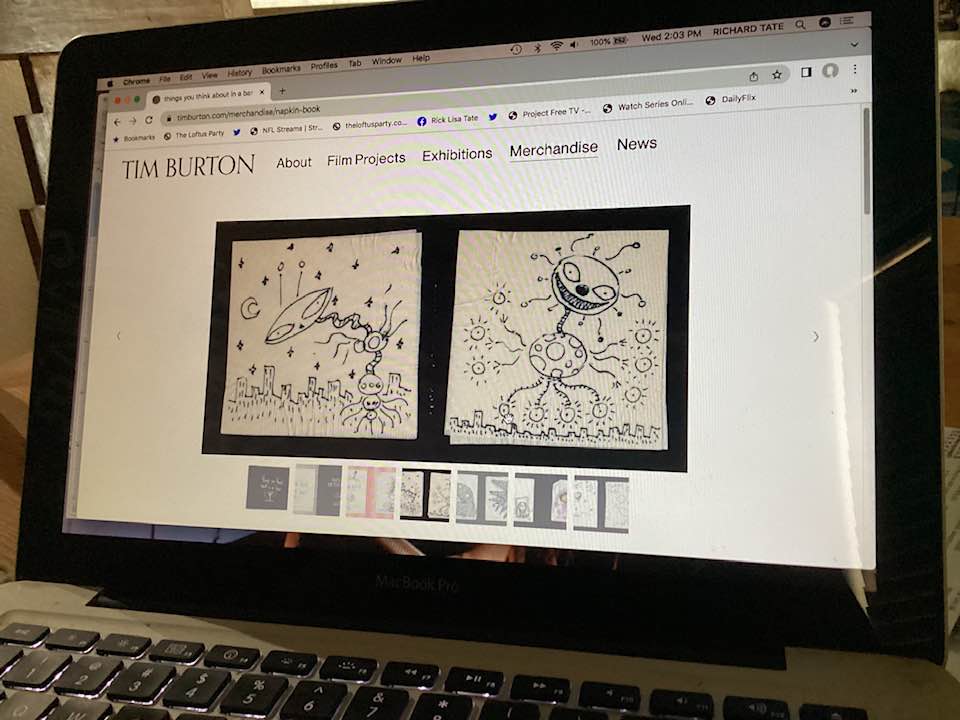
In fact, one of Burton’s art books, things you think about in a bar, is a collection of works he did completely on napkins primarily with simple ink pens.
For this project, find a plain paper napkin, and gather a few pens, to do what may be the easiest, silliest, weirdest, and most fun drawing project in the Be the Artist Series: make some Burtonesque napkin art.
If you look at a couple of the images from the book, it is obvious Burton’s hyper-creative mind and hands were always in motion, doodling, jotting, sketching, and likely making others smile in the process. He didn’t need to use a clean napkin in some cases, and even incorporated items like a cocktail onion in his creations.
We’re going to stick with just the sketches for this project, but you can certainly add anything you want to the picture.
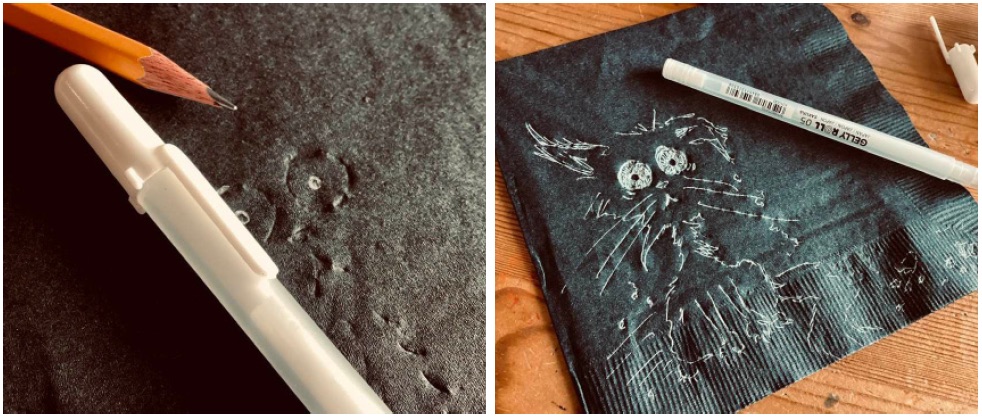
Here are a couple of things to keep in mind before starting. If you feel you need to use a pencil first, don’t use a very sharp one, and draw lightly. Napkins will tear. Larger markers will smear a little, so ballpoint pens, gel pens, and fine line markers are all good choices.
Plain white napkins with black ink are fine, but you can also use any color napkin if you have white or bright-colored gel pens.
Now, simply think of something you want to doodle in Burton’s style: exaggerated features, wavy lines and those “Burton curls,” and just a touch of the weird dreamlike eeriness where Burton’s mind perpetually resides.
It could be an original character, a Burtonesque look at an already existing drawing, or just several little doodles representing your own, quirky world.
If you are brave enough, don’t worry about an initial sketch. These aren’t fine-tuned complicated works; they are simply the musings that traveled from Burton’s head to the napkin. Sometimes, you might not have the final idea in your head until you set the pen to the paper (or paper napkin).
One of the great things about the choice of material is if you don’t like the outcome, use it for a cup holder and throw it away.
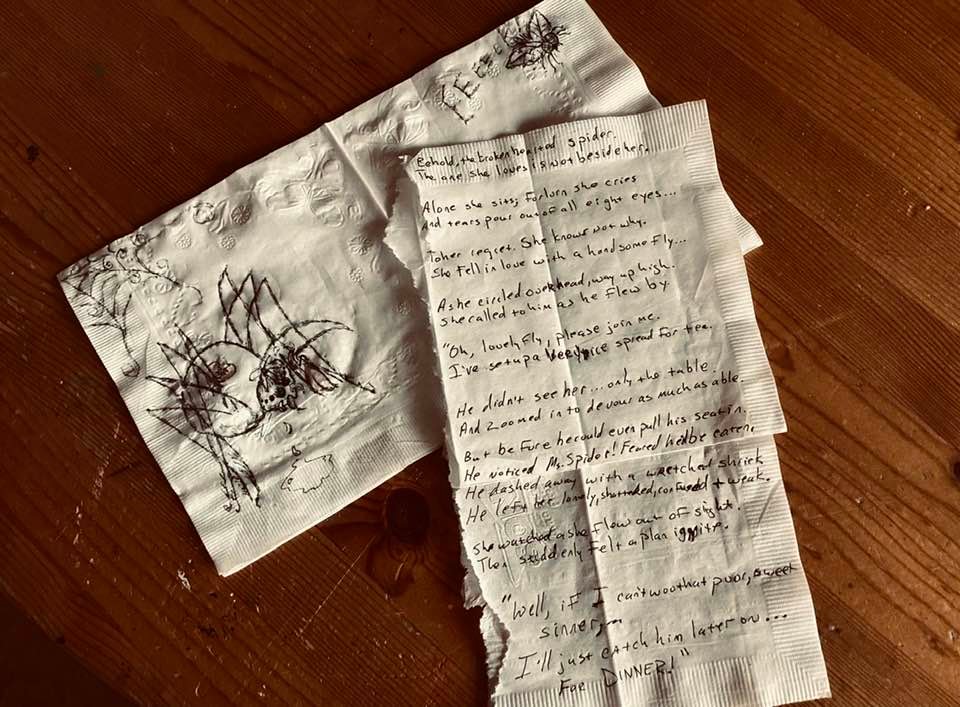
Burton also used his sketches for inspiration for his film projects, or to accompany his writings, as in his poetry collection The Melancholy Death of Oyster Boy and Other Stories. Write a short poem or description on the back of the napkin if you want to add to the world-building.
One of the coolest lessons to learn from Burton and this project is to create when and where the inspiration hits you. If you can’t be at a desk or artist’s station, why not draw a quick idea waiting for a meal with family or sitting on the back patio during a cookout? The results will always be very different, but they will be 100 percent yours… and how you see it.
When his friend Danny Elfman interviewed Burton in 2010 for Interview Magazine he noted “(it’s) good as an artist to always remember to see things in a new, weird way.”
This post was last modified on June 18, 2022 2:49 pm
The fight between winter and the onset of spring is something we know well in…
Out today is the newest Mouse Guard book, 'Mouse Guard: Dawn of the Black Axe'—and…
If you like some extra squares in your cubes, check out the new Rubik's x…
Like many others, I jumped directly into my Apple Music Replay this year filled with…
It's time to stuff the stockings that were hung with care with our must-have stocking…