I’ve been a bit of an obsessive fan of Jane Austen’s novels and some of the adaptations for decades. In recent years, a few Jane Austen-themed games have come out, purporting to be reflective of the Regency era, but so far, to me, they’ve all fallen flat. They either only touch on some of the themes, or they paste a Jane Austen skin on a completely unrelated game. I’ve kept hoping for something more accurate and relevant to the stories, though. So I had my hopes up high when I heard about a new Jane Austen game coming out this month. The publisher sent me a copy to review, and I was happy to jump on that challenge.
What’s It About?
The Jane Austen Game by Ellie Dix and Mandela F-G is a game where players take on the role of one of the six major Jane Austen heroines (one from each novel), and either strive for a good marriage match, or decide to stay single and become a Woman of Independent Mind. (Of course, the latter route requires money, because upper class women were not allowed to work.) Each of those two paths has a different method for scoring points, so it’s important to choose a path early.
What’s Included?
The game is for 2-6 players ages 8 and up, but I’d say anyone under 12 or so would benefit from some significant help the first time or two. The instructions say that the game takes 40 minutes to an hour to play, but the first time you play will probably take at least twice that. There are a lot of steps to each round, and it can be a little confusing, even if you’re familiar with Jane Austen stories.
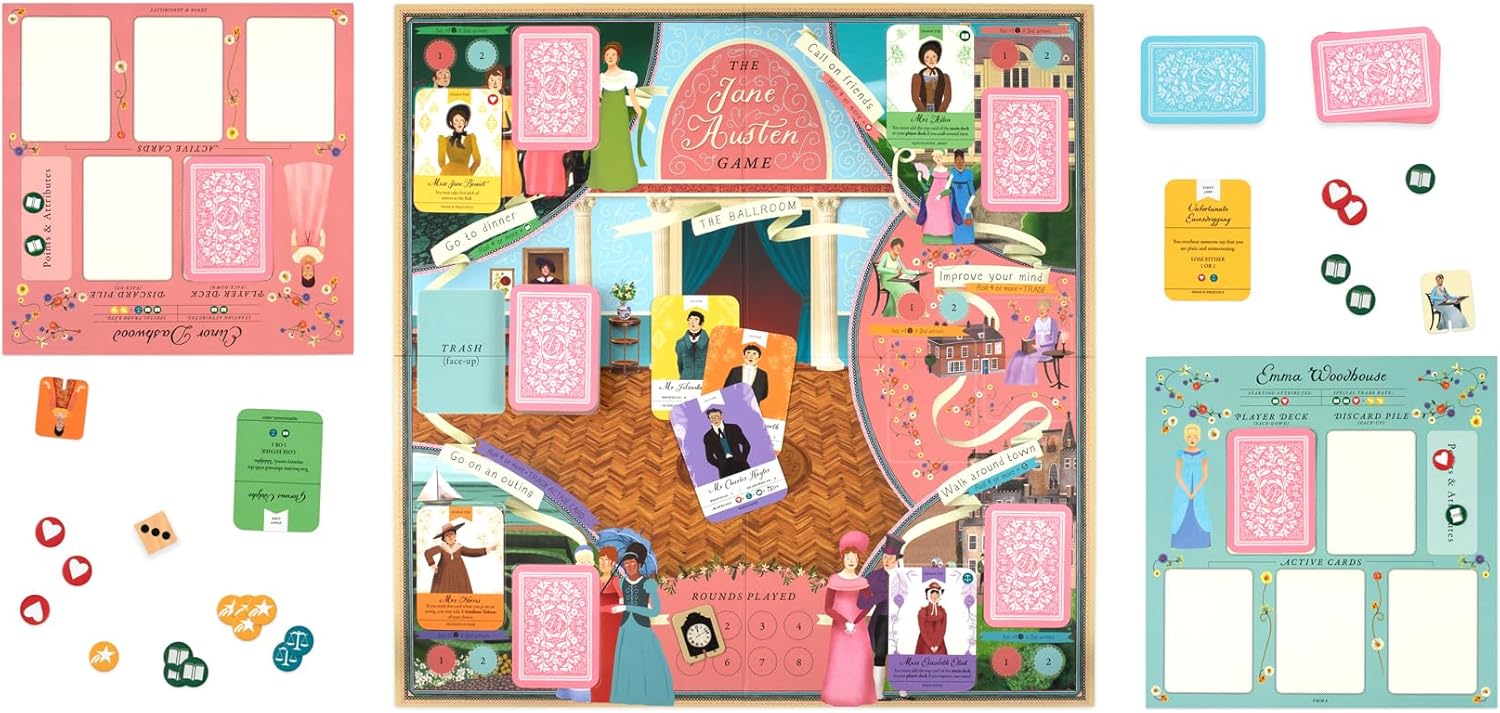
The game includes a gameboard; player boards; decks of cards featuring events, characters, and suitors, most color-coded by which of the six novels they are from; player and game marker tokens; a die; and various attribute tokens reflecting Book Learning, Common Sense, Compassion, and Victory Points. The cards are themed based on actual characters and events in Jane’s six novels, but you’re mixing and matching by playing within all six novels at once.
There is also a detailed instruction manual that will walk you through gameplay, and give profiles on each of the novels’ main characters. There is even an explanation of why a prudent marriage was so key during Jane Austen’s day. It also includes a QR code that you can scan to learn how to play or watch video rules, which is great for different learning styles. You can also access the QR code on the bottom of the box, accessible in the product images here.
How Do You Play?
After each player has chosen their heroine, the game is played in eight rounds, each with multiple phases. Within the phases, players collect attribute tokens, abide by any special rules on their dealt cards, and decide which location to visit on the gameboard. Players can Go to Dinner, Call on Friends, Improve Your Mind, Go on an Outing, or Walk Around Town. Two players can visit each location per round. At these locations, players can collect character cards, reveal suitors, collect tokens, or trade tokens for Victory Points. There is also a mechanic where players roll the included die, which will tell players whether they have to do what is on the drawn Event card, which can be helpful or can hinder your progress.
One of the phases of each round is Attend a Ball, which automatically happens during the first and last rounds, but may also happen during other rounds, if enough suitors are revealed (if there are not enough suitors, there is no ball that round). Just like in the books, you may choose to dance with suitors, but once you say “no” to a suitor at a ball, you may not say “yes” to anyone else that round.
The fact of all main characters being young ladies and suitors being men is very heteronormative, but that’s also how the novels are. Unlike the heroines, the suitors come from all parts of the novels, though, so, in addition to people like Mr. Darcy, Edward Ferrars, and Captain Wentworth, you’ve also got Mr. Rushworth, Mr. Elton, Robert Martin, and even the forgettable John Yates. And don’t forget Mr. Collins. So, you could end up marrying any of these men, depending on your luck and the number of suitors you dance with.
At the end of the game, after the final ball, each player who has chosen the marriage route will receive an offer of marriage from one of their suitors, but it is kind of random, so you have to be careful who you’re willing to dance with at each ball. Less desirable matches score you fewer points. If you’d prefer to not marry at all, you can spend the game racking up Victory Points by Improv(ing) Your Mind, but it does take some effort to end up with more points than someone who has married even a middling suitor.
You win by having the most points at the end of the game, which can be gotten by collecting Victory Point tokens, marrying a suitor, receiving proposal points from other suitors, or becoming a Woman of Independent Mind. If you have enough suitors, chances are that you will not end up with your first choice—since there is the element of chance in play here—but such was life during Regency times. You couldn’t turn down very many suitors before you might be labeled stubborn and unmarriageable, so you might have to say “yes” to the first acceptable offer.

Do You Need to Be Familiar with the Regency Era or Jane Austen’s Stories to Enjoy This Game?
No, not really. You can definitely effectively play the game with what is in front of you. But you’ll understand more of the references and the reasoning behind why some of the characters and suitors are valued the way they are if you’ve read the books or seen the movies. It is also faster and easier to choose suitors if you’re familiar with the stories, as the characters who are rich and nice are worth more than the ones who are cads, though there are plenty of men who are nice but not rich who score decently.
Is It Any Good?
I was hoping for a game truly reflective of Jane Austen’s storylines, but did this game deliver? Yes, I’d say it definitely mostly delivered. It’s the best Jane Austen-themed game I’ve seen yet, and more like the plots of the novels than any other game I’ve heard of. My family had some notes, though, of ways it could be improved (see next section).
One challenge while we were learning how to play is that there are a lot of phases to each round and steps to each phase. I think you’d have to play it a bunch of times to remember them all. Plus, if you go the marriage route, there are so many numbers to use in figuring your score that it might be hard to strategize. But we found that, after only playing twice, we all remembered what to do.
Our Improvement Notes
My family did have some suggestions about how to improve the game. For one, the instructions seemed overly complicated and confusing, not always giving you information about the current phase of the round where you need it. So you really do need to read the instructions through a couple of times before playing, and they are long instructions. It does become a lot clearer how to play and strategize once you’ve played once or twice, though.
If you choose to go the Woman of Independent Mind route, it’s a hard road. If more than two people are playing the game, there’s no guarantee that you can always choose the Improve Your Mind option, and there are very few other ways of obtaining Victory Points. And, if an Event happens and you don’t roll high enough, you lose the opportunity to trade for Victory Points that round completely, instead needing to do what’s on the Event card. The included die is made of wood, and ours kept rolling 2s, which kept us from avoiding the Event card action. So my advice is to use your own, well-balanced die, or, better yet, do away with the rolling altogether, and give each player the option of either taking the Event card action or the action for their location. Or, perhaps have the option to do both!
We think the game needs more than eight rounds, especially if you have the rolling mechanic. Otherwise, it’s far too easy to miss out on the actions you can take at the different locations. I’d recommend maybe 12 rounds? That would also make it more likely to have a third ball, and thus more suitors, as two balls makes the game less fun, less interesting, and less strategic. Because the deck contains so many characters and not that many suitors, it takes a lot of churning to populate a ball.
There are also a few cards whose implementation could be up for interpretation. So, agree ahead of time how to use them.
In addition, some advice: If you’re looking for suitors, I advise gaining any suitor that you can early on, in that first ball, just so you have at least one. The only other guaranteed ball is in the final round, when it might be too late to have much choice.
Conclusion
The Jane Austen Game is a really fun way to somewhat immerse yourself in the marriage game of the Jane Austen world. The base rules aren’t perfect, but it’s very easy to make a few minor changes to suit your game-playing tastes. This game was fun for all of us at my house, two of us very familiar with Jane Austen, one with a medium familiarity, and one with very little familiarity.
I’d recommend it to anyone who enjoys games that are not just like every other game out there, and to anyone who just enjoys a good Jane Austen experience.
Note: I received a copy of the game for review purposes.