
You might think that the Choose Your Own Adventure (CYOA) series of books and the concept of a tarot deck would be fairly incompatible, but learning more about ourselves and the world around us through careful reflection is just another adventure, with far more choices than any book can contain. And getting to experience that by immersing yourself in art that’s reminiscent of childhood? Priceless.
I’m coming at the Choose Your Own Adventure Tarot Deck as a complete tarot newbie (but CYOA devotee). Sure, I’ve heard of tarot decks and have seen a few cards here and there in popular culture. But I didn’t know anything substantive about the history of tarot, how to use a deck, what each card might indicate, or whether it’s totally just “woo” or if it has anything to offer me, someone who is decidedly not into “woo” things.
I am into card decks, however, ones that help me consider different aspects of my life, and help me to both focus and focus on my priorities and values (such as The Live Your Values Deck). So, I thought I’d approach learning about tarot and using these CYOA cards from that perspective.
But I needn’t have worried.
What’s Included in the Set?
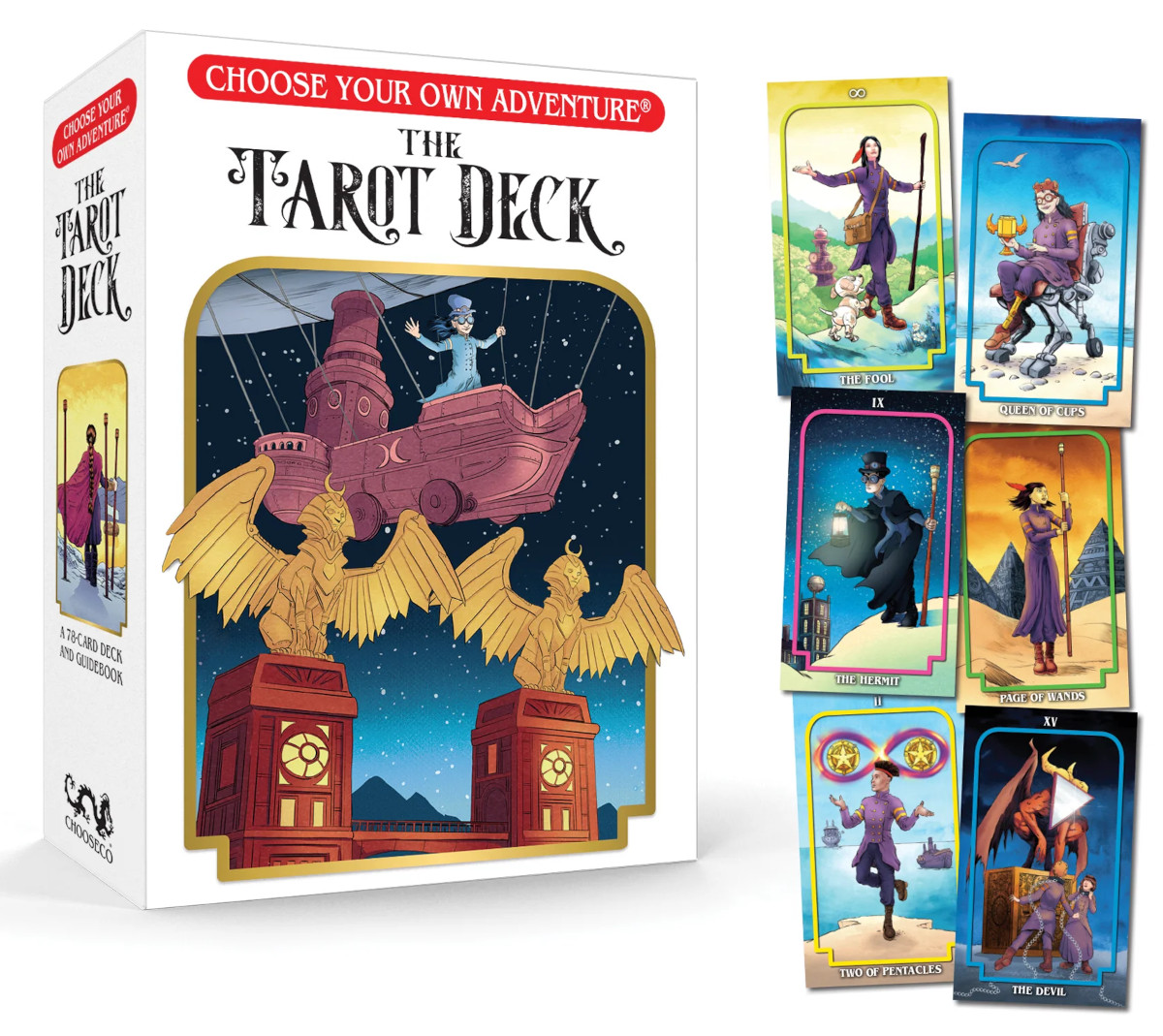
The set includes a full tarot deck, along with a long and detailed guidebook, all in a sturdy, protective box with magnetic closure, easily fitting the cards and the guidebook. And, if you don’t like the cardboard insert, you can make your own insert, or wrap the cards in a special cloth, or whatever you like.
Illustrated by Brian Anderson (who illustrated Murder at the Old Willow Boarding School), the 78-card tarot deck has art that features diverse young people in steampunk-inspired style, all while looking distinctly like CYOA book art. The art on these cards take me back to my childhood love of the Choose Your Own Adventure books, so I was predisposed to like them.
And, as I dove into the decently thick (128-page) guidebook for helping users make sense of the deck, my predisposition was supported. It’s written by author and tarot practitioner Rana Tahir, who explains the meanings of all the cards and their symbology, and how to go about doing a reading. Tahir is a CYOA author as well, and is a compelling writer. I did not expect to be so engaged by what I read there.
But a heads up: The cards and the book are both really slick, both literally and figuratively. If you’re reading the guidebook in direct sunlight, be careful about reflections so as not to blind yourself. I learned that one the hard way!
What’s in the Guidebook?
The accompanying booklet (which will apparently also be available as an ebook, for those who like to travel light) goes into some fascinating tarot history, explains how to use a tarot deck and interpret the cards, and provides explanations of each of the tarot cards in the deck, both the Major and Minor Arcana, with a thorough explanation next to an image of each card. There is also a short glossary and bibliography/reference page. The whole book is incredibly helpful, especially to someone like me who is completely new to tarot. The history, the process, and the card meanings are explained in enough detail to be helpful but not so much that it’s overwhelming.
My advice, especially if you’re new to tarot like I am: Do not skip reading the section on the history of tarot. While the author does seem to believe somewhat in magic and related things that I consider “woo,” she is clear about the origins of tarot and that it is an invented thing, passed down through the generations. It has a surprising western European origin/influence, and reading this section really helps put tarot into context for the curious and for the practitioners of it. The author is also clear about the importance of science and critical thinking in your life and understanding of the world, even going as far as saying she unfollowed certain tarot practitioners who denied the science behind the COVID-19 virus. That got me to pay closer attention to what she had to say.
It seems that, in the end, what you get out of a tarot reading is what you bring to it. As the author says, “Tarot is an exceptional tool for self-reflection. It is an excellent way to externalize my worries and questions so that I can look at them from a distance.”
And who wouldn’t benefit from that?
What Are the Cards Like? How Can I Use Them?
The deck is based on a popular deck format, the Rider-Waite-Smith deck, for those familiar with tarot. You can use the cards as you might use any tarot deck, just with the added bonus of immersing yourself in an art style from your childhood (assuming you read Choose Your Own Adventure books growing up). There are so many details to each image that it’s easy to get a personal feel for each, and contemplate what comes to mind, other than or combined with the traditional meanings.
The deck includes 22 Major Arcana cards (for “overarching themes and lessons in life”) and 56 Minor Arcana cards (for “day-to-day obstacles and lessons” in regard to the Major Arcana themes). The author describes how, in our lives, we go through the phases of the Major Arcana multiple times, learning something new each time. I really like this idea, where our lives are lived in phases (though I call them “chapters”), needing to revisit things over and over again to learn the lessons from them, constantly learning new things about ourselves and also reinforcing (or relearning) lessons learned previously.
In that sense, doing tarot readings can help your mental health, if you use them properly. They can help you examine parts of yourself and your life that you want to face or process or reinterpret. They’re good for reflecting on where you are, where you’ve been, and where you’re going. They’re a tool for thinking about things, how you’ve grown, what you want to happen.
I won’t go into how to do tarot readings here, because I am completely new to this practice and am not a knowledgeable source. So, I encourage you to read the author’s instructions in the guidebook, and also seek out other practitioners who resonate with you and your priorities and tarot habits.
Who Is This Deck Good For?
I think this particular set of tarot cards would be good for most tarot enthusiasts, but especially those who have more modern sensibilities, and definitely for those who were kids in the ’80s, or spent their childhood reading ’80s books. The art is a spot on match to the style from CYOA books, and I can imagine pretending to find this deck in the Cave of Time.
The deck and accompanying guide are purposely aimed at young people (‘tweens and teens), but I feel that anything well made can be for anyone. The content isn’t specifically juvenile, so it’s for the kid at heart as well as modern young people. The instructions even address how to look at any gendered terms that come along, and encourage people to consider cultural leanings of interpretations and how they may or may not apply to your reading. Imagery reflects a modern perspective, such as The Lovers card featuring two masculine-presenting people, and The Emperor is a wheelchair user.
This deck is also great for newbies like me, because the accompanying guidebook does a great job walking you through how to use and interpret the cards, and encourages you to figure out, practice, and hone your style. Apparently everyone has their own perspective, process, and style when doing a reading, for themselves or for someone else, which was news to me.
Conclusion
It now makes sense, from my perspective, that the Choose Your Own Adventure folks would make a tarot deck, as tarot readings are a bit like Choose Your Own Adventure stories but for your own life. You can take away from the cards or from a reading whatever is useful to you, whatever direction you want to go in, however you want to frame the experience.
In the end, did this tarot deck help me with anything? I mean, it didn’t tell me what my future will hold. I don’t believe in magic or fortune telling. But it did get me thinking about things in new ways and from new perspectives, simply because it and allowed me the opportunity to break out of my usual trains of thought. The prompts from the cards that a reading provides are always good food for thought.
The Choose Your Own Adventure Tarot Deck can be had starting today for less than $25. It’s a great companion to have on all of your life’s adventures, and it’s just plain neat. Immersing yourself in the art during your readings feels a bit like a time machine to me, and I hope you’ll come away with some new insights.
Also, check out my GeekMom review of CYOA’s super mathy book, The Dregg Disaster!
Note: I received a sample for review purposes.