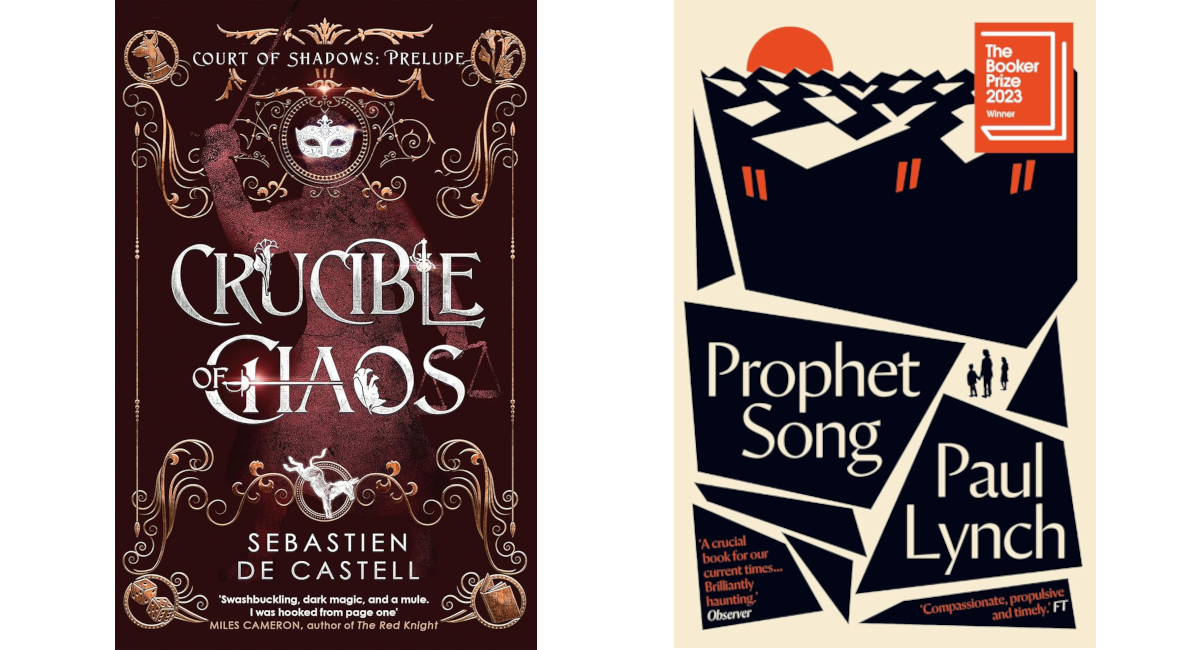
A heavy reading month, which was lovely, but a busy end-of-month schedule means this August 2024 book review roundup is a little later than usual. This August, I read nearly every book in my pile (I haven’t finished Sandra Newman’s Julia yet. More of that alongside 1984, in next month’s reviews). Not only that, I took an extra book, that arrived mid-month, on vacation with me. I’ve become a big fan of Sebastien de Castell’s novels, so I was thrilled to read Crucible of Chaos, which the publisher kindly sent me.
I’ll start the roundup with Crucible of Chaos. This is described as a prequel to the Court of Shadows series, that began, this year, with Play of Shadows. Both novels are set in de Castell’s Greatcoats universe. While familiarity with the Greatcoats wasn’t necessary for Play of Shadows, I feel like I would have missed something when reading Crucible of Chaos, if Play of Shadows hadn’t given me at least a rudimentary understanding of what Greatcoats were and the underpinnings of their role as law enforcers.
Having said that, there is no need to read any previous de Castell novels to enjoy Crucible of Chaos. Lead character, Estevar Borros, is the King’s Crucible; a washed-up, overweight, swashbuckling Hercules Poirot. He has been sent to the Isla Sombra at the request of the island’s Abbott, only to find the island has descended into chaos. The Abbott has been murdered and the remaining monks have split into warring factions, all mistrustful of each other, and all glowering at the others with murderous intent.
What follows is an investigation that is a blend of politics and supernatural intervention. It bears little relation to Play of Shadows but hints at the same hidden forces that lurk in the background of the first Court of Shadows novel. This prequel isn’t quite as playful as Play of Shadows. Its dour setting and limited cast, don’t give the author as much opportunity to inject the same level of swash, buckle, and comedy.
Nevertheless, I enjoyed The Crucible of Chaos. Fantasy procedural crime novels are an underrepresented genre and Sebastien de Castell pulls this one off with his characteristic aplomb.
I often struggle with (or actively avoid) reading winners of the Booker Prize, but I very much wanted to read Prophet Song, because I have a morbid fascination with dystopian novels – though the older I get, the more depressing I find them. When one has three children, visions of the end of society are all the more scary.
Prophet Song is horribly readable. It’s accessible in a way that prizewinning books often aren’t. It reminded me a lot of Cormac McCarthy’s The Road. Both are bleak reads.
The book is set in Ireland, not long after a new authoritarian government has come to power. It tells the story of Eilish Stack and charts the disintegration of Irish society and its toll on Elish’s family. It starts when her husband, Larry, a spokesman for a teaching union is taken in for questioning by the regime. He never returns. Whether he is dead, or imprisoned, Eilish cannot discover.
Prophet Song deserves a full post all to itself, but I’m not sure I’ll find the time to write one. It’s an artfully constructed novel, that not only depicts the slide of a democratic nation into authoritarianism but also examines why people stay in terrible conditions when escape routes are available to them.
Considering much of the world finds itself in conflict, Prophet Song offers a sobering insight into the lives of those living in a war zone. Eilish’s descent down the rabbit hole is chilling and the novel’s denouement is extremely powerful, especially when examined against the United Kingdom’s refugee policy in recent years.
Good fiction makes you think and, measured on that alone, Prophet Song is an excellent novel. One that will be read for many years. It will probably be the best novel I read this year.
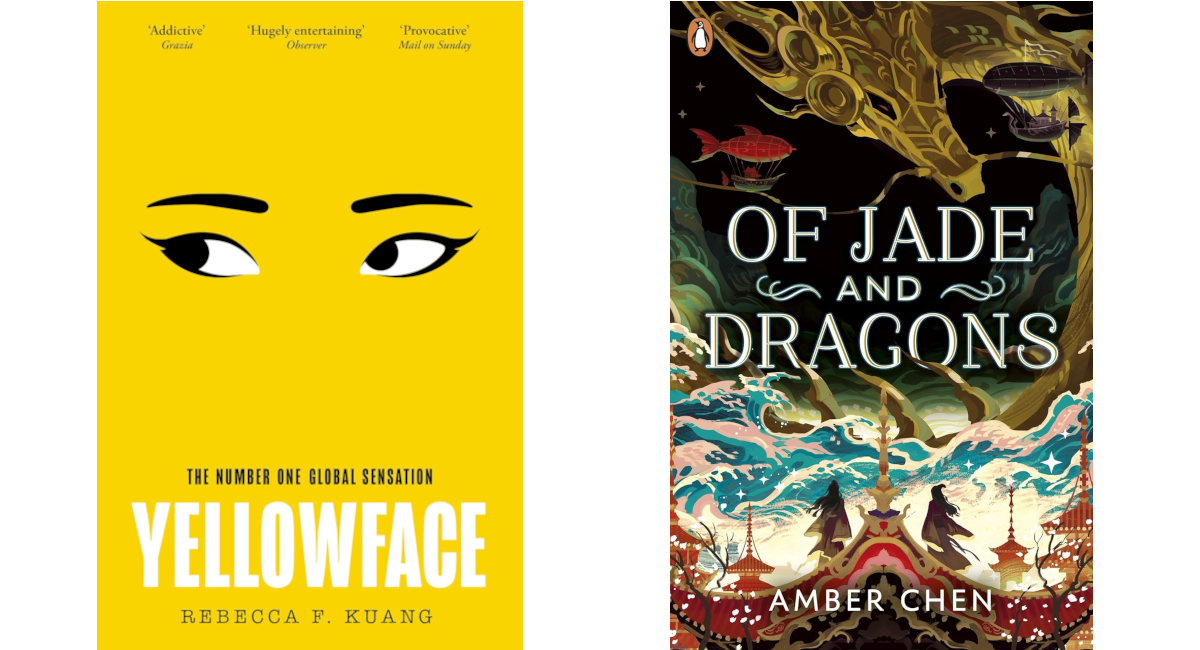
Of Jade and Dragons by Amber Chen is a fantasy inspired by Chinese myth. A young engineer called Aihui Ying disturbs an assassin sent to kill her father. Unable to prevent his death she can at least discover who his killer was, and perhaps avenge his murder. To do this, Ying must enroll in the prestigious Engineers Guild.
The structure of the book is familiar. The engineers guild has a rigorous entrance exam, involving schooling and trials. Only the best will make it. On the plus side, failure doesn’t result in certain death. Women aren’t allowed in the academy so Ying must disguise herself as a man (making the book read very like She Who Became The Sun) If that wasn’t hard enough, she also has the side task of working out who in the city sent the assassins to kill her father.
Ying discovers that her father had been tentatively working on new explosive devices to help in the war effort. Ying’s investigations draw her inexorably into the politics of the kingdom, as does the inevitable love interest.
I said in my preview post that I wasn’t quite clear if this was a young adult novel. I suspect it isn’t envisaged as such, but there is no reason why Of Jade and Dragons couldn’t be enjoyed by that audience. This is not an adult romantasy novel. There’s some romance but it’s all very chaste.
I enjoyed reading Ying’s exploits, in particular the novel’s setting, although in terms of characterization and plot little new ground is broken. I often felt that Ying’s secrets were never probed too much and she seemed to be able to come and go wherever she liked to a hard-to-credit degree. The novel’s conclusion was different from how I expected, in a good way. Whilst a second novel is certainly possible, Of Jade and Dragons is a complete story in its own right.
My book group choice for August was Yellowface by RF Kuang. A book that had so much hype it was probably always destined to feel a little disappointing. It’s certainly very readable.
The premise of the book is that struggling author June Hayward is friends with Athena Liu, a literary superstar who is American Chinese. Liu collapses and dies right in front of Hayward, who does what any friend would naturally do – steals the first draft of Athena Liu’s next book. Due to the secrecy of Athena’s writing process, nobody else has seen the book or knows anything about it.
The key to Yellowface is that Athena’s manuscript – based on the lives of Chinese laborers in World War I – is only a first draft. It is in no way publishable. Taken with it and imbued with a zeal to make it publishable, Hayward works long and hard at the book to produce a finished article. This is loved by her publishers and published to huge acclaim. She never acknowledges (to the outside world) where the idea came from.
The takeaway from this novel is that it’s not the lie that kills you, it’s the lies you tell to cover up the lies. The book also serves as a critique of the publishing industry and probes into the rights and wrongs of cancel culture. If you followed book Twitter (back when it was Twitter) you’ll know there was often much agonizing over who could (was allowed to) tell stories. Can writers tell stories based on the lives of groups they don’t belong to? The most famous case is that of American Dirt. The arguments are complicated and nuanced and Yellowface highlights this in ways that social media never could.
I would love to have read Yellowface divorced from its hype. It’s a good novel, but perhaps not as amazing, as its popularity would suggest, but perhaps my expectations were too high? Yellowface is very much a novel of its time, which made me feel old. It poses several difficult questions, many of which remain unanswered because they don’t have easily formed responses. The answers stand on shifting sands of opinion, time, and the people involved. All in all, Yellowface is a provoking read that prompted a lot of discussion and admiration in our (almost entirely non-diverse) book group.
I reviewed Adam Roberts’ Lake of Darkness in full during August. It’s the hardest sci-fi novel I’ve read in a very long time. Pared-down prose, complex black hole science, and deeply philosophical questions about the nature of evil makes Lake of Darkness feel like a ’60s science fiction novel of ideas, like something Ursula K Guin might have written. It was hard going at times, but I’m glad I’ve persevered. Much like Prophet Song above, it is a novel my brain keeps referring back to as I try to puzzle out its secrets.
The Waterstone’s SFF pick that I read in August was Ink Blood Sister Scribe by Emma Törzs. This was a great holiday read. Its premise is that magic exists in books, but that only certain people can read it and even fewer people, “scribes,” can write it. The book has a feel of Lev Grossman’s The Magicians about it, and is dark academia adjacent, meaning it chimes with a current big trend in fantasy fiction.
I found its premise intriguing and it was certainly readable. The thrill of why sister Esther is being chased across the world, in a complex magical game of cat and mouse was compelling. I didn’t quite find the end of the novel held up the promise of the first two-thirds, but it was an entertaining read, perfect for relaxing at the end of the day.
Anybody who regularly follows my posts will know I love a good children’s mystery. I also like a reimagined fairy tale, so the dovetail of The Beanstalk Murders was just about perfect for me. You can read my full review of P.G.Bell’s book here. If you’re looking for a fun crime caper book for your children or grandchildren, definitely check it out!
Bookshop.org links are affiliate links. I received some of the books in this piece for review.
Click through to read all of “August 2024 Book Review Roundup!” at GeekDad.If you value content from GeekDad, please support us via Patreon or use this link to shop at Amazon. Thanks!
If you like some extra squares in your cubes, check out the new Rubik's x…
Like many others, I jumped directly into my Apple Music Replay this year filled with…
It's time to stuff the stockings that were hung with care with our must-have stocking…
It's time to get styling and stocking up on everyday necessities that we think you…
Every geek loves a new gadget. Here’s a selection from the GeekDad and GeekMom writers,…
If you enjoy 3D printing with filament and are interested in something new, resin printing…