
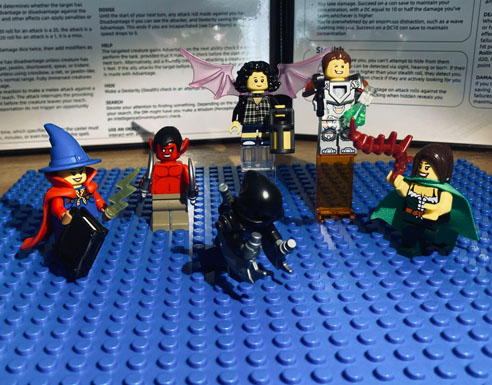

Now that you’ve decided that LEGO makes for a great RPG miniature, and you’ve explored how to represent species through LEGO, it’s time to look at class and equipment features. Many classes have iconic features or equipment, which means we can use the accessories on our minifigure to represent the class of the character. Note that this article will not be covering spell effects, creatures, or wild shape options. Those subjects will be in Part 3.
Armor/Lack of Armor
Choosing the correct armor, or lack of such, can make a huge visual difference in the overall feel of a miniature. A dwarf barbarian might use a chest element that has no shirt. A spellcaster might wear a billowy cape, a plain cloak, or a spooky cloak. A wizard might be distinguished from a ranger by their hats, and the choice to use a utility belt might distinguish a rogue from a monk. It’s important to think about the features you want to be noticed at the game table, whether you’re considering belts, armor, or even what the character is holding. After all, if your mini is holding a dagger rather than a sword, it won’t look so much like a fighter, and if the gear doesn’t match, it can add confusion as to what you’re trying to portray with your mini.
The core feature of armor is the chest element. This element may be painted or plain, and has arms attached to it. Choosing whether to use a piece with removable armor on it will give a much bolder appearance than a character with armor printed on, or no armor. Likewise, specifically using chest elements with bellies, chest details, etc. can really highlight the unarmored nature of a barbarian or monk. There are countless options for color, style, and cost, so find the pieces that are worth the investment, and don’t get too hung up on making everything perfect. There’s no sense is spending $20+ on an out-of-manufacture miniature through resale when you can get all of the elements through Pick-a-Brick or by being a bit inventive.
Armaments
One of the most crucial (and flexible) parts of using LEGO to represent your character is their go-to equipment. A wizard might carry a staff and spellbook while a ranger carries a bow and a bone treat for their companion. Even melee combatants can be differentiated by the types of handheld items they hold. An artificer can hold a wrench or potion in one hand, while a paladin might carry a mace and shield. Anything can be an armament, from a banana to a disembodied LEGO minifigure head. Using your creativity, and the wide options available for color and style, you can create the perfect gear for your mini.
A Note on Weapons
Don’t get discouraged if there isn’t an exact match for your weapon, particularly magical weapons. The chances are, you can make what you want if it isn’t available. There are many kinds of swords, daggers, and bladed weapons, but if you want a scythe for your grim reaper, you can attach a sickle to a staff to get the same effect! Your wizard has a fancy-schmancy staff? Take a shorter rod and attach a decorative element to the top. The sky is the limit here, if you’re creative enough.
As you can see in the images above, most weapons or specialized gear only require a rod, a connecting piece (including but not limited to lightsaber handles, and t-connectors), and a small assortment of decorative elements. By mixing and matching, you can create a nearly infinite number of unique weapons for your characters.
Other Elements
Thanks to the long existence of diverse needs for LEGO builds, there has been demand for countless unique or multipurpose LEGO elements which you can repurpose to represent nearly anything. Magic items, weapons, and even mundane adventuring gear can all be customized to represent your ideal character. Whether you’re looking at putting packs on your horse or carrying buckets of flower petals, what you need likely exists if you can use your LEGO in creative ways.
TL;DR
Thanks to the countless and abundant LEGO elements in the world—and the ongoing nature of their product release cycles—you can find almost anything in a nice color, or at least in a suitable color through services like Pick-a-Brick or in-store shopping. If all else fails, dredging through your existing collection can yield pieces you can use creatively to represent your character at the game table. Don’t be afraid to get weird with it, mix things up, and try new stuff. You never know what will be you next genius build.
If you’re joining us in the middle of this series, see Part 1: Species to learn how to represent your character’s physical species features such as tusks, beaks, wings, and skin tone with LEGO. If you’re not sure that LEGO minifigures are the right minis for your game, check out our article on How to Choose the Perfect Dungeons and Dragons Mini.
Disclaimer: LEGO has previously provided some of the elements featured in this post for evaluation and review purposes. This article is not sponsored or endorsed by LEGO. All opinions, images, and suggestions are generated independently by the author.
Click through to read all of “How to Make any D&D Character with LEGO—Part 2: Class and Equipment” at GeekDad.If you value content from GeekDad, please support us via Patreon or use this link to shop at Amazon. Thanks!


