

This summer’s Be the Artist series asks the question, “Who Made That?”
The Art: The Bean
The beautiful silver bean-shaped sculpture is called Cloud Gate, and it is inspired by the unique properties of liquid mercury. It is also one of the best-known sculptures in the very artistically savvy city of Chicago.
That is no small feat for this piece to be a standout. Chicago’s public art scene features some pretty big names including Pablo Picasso, Alexander Calder, and Elizabeth Catlett, but it is the simple, beautifully reflective Cloud Gate that often makes the cover of art guides, tourism books, pamphlets, visitor’s guides, you name it.
Locals gave it the nickname “The Bean,” and it is well-known and well-loved. But who made it?
The 2004 sculpture located in Millennium Park is the first public outdoor work in the United States by British artist Anish Kapoor, who utilized computer technology to create 168 plates of stainless steel to form a curved shell that basically breathes with the changing weather conditions throughout the year. It is also one of the world’s largest outdoor sculpture installations, weighing more than 110 tons and stretching some 66 feet long and 33 feet high.
Anish Kapoor was born in Mumbai in 1954 (then Bombay). His father was a hydrographer and physicist in the Indian Navy. He moved to the United Kingdom for his art studies at Hornsey College of Art, then on to Chelsea School of Art and Design.
In the 1980s, his biomorphic works blended art and science, taking advantage of simple, geometric shapes and materials such as granite and marble. He created large, curved figures that were often bright and monochromatic. He works with contrasts between space and work, ranging from dark voids to bright shining objects.
Kapoor, now 70, has notable works all over the world including Sky Mirror featured at New York’s Rockefeller Center and London’s Kensington Garden, Leviathan in Paris, and Turning the World Upside Down in Jerusalem.
He has received honors and prizes from around the globe, not just for his groundbreaking works, but also for his advocacy for refugees and displaced people. He was bestowed Knighthood in 2013 by Queen Elizabeth for his achievements in visual arts.
As for Cloud Gate, Kapoor explained in a 2008 description for Millennium Park that he wanted to make something, “that would engage the Chicago skyline (so that) one will see the clouds kind of floating in, with those very tall buildings reflected in the work.”
And it certainly gets attention from locals and visitors every day.
The Project: Look Into the Void
Kapoor’s works and styles are so vast that it is hard to pin down an easy DIY for all ages. It took a little thinking to create a project that would both celebrate the very deep thoughts and ideas of Kapoor and make for a fun afternoon project.
Well, there is one interesting thing about Kapoor that even those who aren’t in the arts community might know about: he purchased Vantablack, the “world’s blackest black,” also known as “world’s darkest material.” In 2014, Surrey NanoSystems promoted a pigment that could absorb 99.965 percent of visible light, creating a void-like aesthetic of pure darkness. Cool!
This purchase later resulted in controversy between another artist who retaliated with his own “pinkest pink” that everyone but Kapoor was allowed to use. That is neither here nor there, as we are going to use simple store-bought black or any color for our project.
Kapoor’s work with Vantablack (and sometimes with other pigments) often dealt with experimenting with the physical vs. the non-physical forms of art.
This is, in a very, very simplified manner, what we’re going to try. Create a beautiful void.
Since many of Kapoor’s most famous and impressive works are installations, we are going to take advantage of using what we have to create it.
First, since we don’t have access to the world’s darkest materials, we need a source of negative space: a little paper cup, a cardboard tube, a tiny box, a plastic toy horn, or anything else you can find with a concave center.
Next, we need a small piece of thick cardboard at the bottom of a cardboard box for a background with which to create a contrast.

Trace the open end of the “void” source in the center of the cardboard. Then cut a hole slightly smaller than the traced shape.
Take the item you are using for the void and paint the inside a thick, solid color. Black, red (Kapoor has done a lot of work with red wax), silver, or any solid color you want. Glue the void on the back.
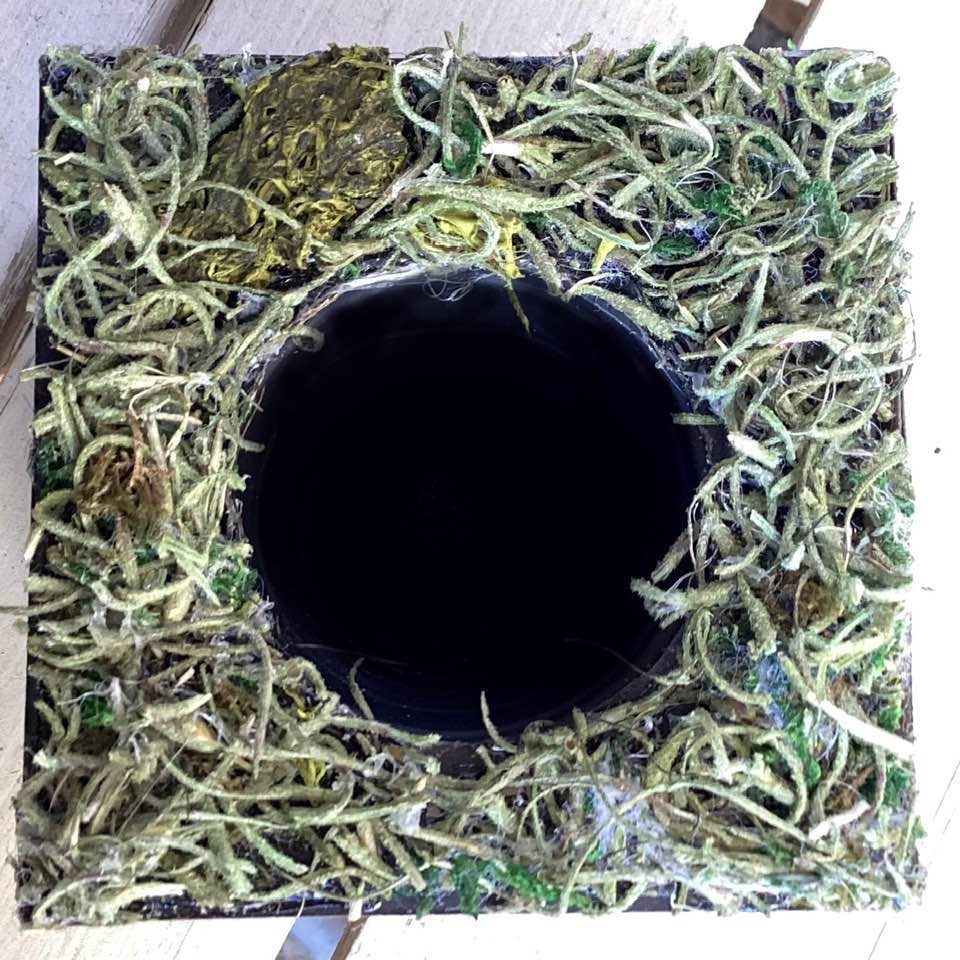
Now, to create a contrast, paint the front of the cardboard space with a color light (or dark) color that contrasts the void, or cover the surface with a texture such as small stones, artificial moss, little mosaic pieces, or whatever you think will best make your void become more noticeable.
It is fun to come up with more than one idea and see how they complement each other or stand out as their own ideas.

Now set it up and watch the reaction. This was a simple project, but watching the response is part of the process. Watch how people will be drawn to the “negative space.” See if they focus on the center of nothingness and void in the middle of a very solid surface. This, in a small way, is a peek at how Kapoor crafts a new shape out of the mystery of nothingness. The physical meets the non-physical.
Cloud Gate may be about something reflective and bright, while many of Kapoor’s works were about using “non-space” to create a new unfamiliar space in our familiar world:
“Sculpture has been about physical space: here, three-dimensional, projecting,” he said in a 1990 article with BOMB Magazine. “The thing that I seem to be doing is the opposite. Making sculpture un-three-dimensional. The physicalness of the stone is about non-physicalness. About fear, about the other place, taking in rather than giving out.”


