“I’m the swine you love to hate.”
“When isolation leads to madness, a revolution of the masses.”
For this smoking volcano of Xennial feminist rage, music both fuels the fire and calms the spirit. Coming to adulthood in the late 1990s meant the music that raised me included artists like Nine Inch Nails, Green Day, Hole, and Garbage. While I wouldn’t realize this until recently, these voices that I heard everywhere—from school dances to radio stations that my alarm woke me up with in college—explained to me the reasons for disaffection, rebellion, and a need to unmake unjust systems.
In 2024, Le Destroy’s Trashumanism gives us the same narrative and sound, allowing us to feel our anger at unjust systems and continue to rage against the machines that treat us as disposable cogs in a larger system. However, the narrative of this album is greater than the sum of its songs. The “silent” graphic novel Trashumanism creates a vivid world much paralleling our own in ways, creating an overarching narrative that both rails against humanity’s destructive nature and reminds us that we have the ability to inspire. As the project looks to the future, fans can expect a tabletop role-playing game (RPG) that takes the graphic novel’s characters into a fully developed world.
Attending the Trashumanism panel at New York Comic Con (NYCC) and sitting with Le Destroy (aka Kristina Olson), this rage-fueled Xennial discovered a new soundtrack for and visual expression of my current place in life.
Trashumanism: The Album
During the panel’s Q&A, one audience member referred to the album’s sound as “neo-industrial.” When I sat to prepare for the interview and panel, the first thoughts I had—before doing online research—were that the music was giving “if NIN and Hole had a musical baby.” Going further into my research, I found that my initial assessment made sense. According to the bio, Olson worked with “former Nine Inch Nails collaborator Danny Lohner on the release with Josh Freese on drums,” and the work was “highly inspired by The Chemical Brothers, The Prodigy, Prince, Madonna, and Garbage.”
Although Trashumanism is not Olson’s first foray into music, it is the first project where she wrote and did all the pre-production work, having 100% control over the vision. According to Olson, working with Lohner elevated that vision and the music. “What I really love about working with Danny is that when I give him a song, he understands what the song needs—what the song is. His touch is there, but it’s not overbearing. He’s so incredibly talented—a true artist and a nice dude.”
During the panel, Olson explained the three main themes that merge and blur across the album:
- Opposition: fighting against the overlords, people trying to take away your autonomy
- Advocacy: championing people or groups who can’t do it themselves
- Embracing the human experience: leaning into the qualities that make you unique without having shame for who you are
The title Trashumanism is a riff off the term “transhumanism,” a philosophical movement that believes people should use technology to modify and enhance their existence to overcome biological constraints. Although the album parodies the term itself rather than taking on the movement, the artist’s perspective on technology is more practical. She explained,
“You can’t put a blanket statement about technology. We have to take it on a case-by-case basis and see how things are being used. Scientific advancement and knowledge just for the sake of knowledge and experimenting to gain it. Where is the endpoint? That’s the issue. A lot of people do that for the sake of doing something but not realizing where the end is going to be.”
The album pulses with the emotions borne from the current and potential outcomes that we’ve seen technology bring to society and the arts. Infused with the same industrial beat NIN fans will recognize, the album is an emotional ocean, with waves of anger and rebellion rising and falling, cresting, and waning.
The title song, “Trashumanism,” begins with an electronic beat to introduce Le Destroy as she almost gasps the lyrics, “Use. It. Up. / Take. It. All. / You create the filth that you live in / a parasite, you will never be forgiven.” Meanwhile, later during my favorite, “Memento Mori,” she sings, “You want to see us crumble / you want to watch us crawl” before announcing the chorus “We will live / we will live / even if we die.”
Trashumanism: The Silent Graphic Novel
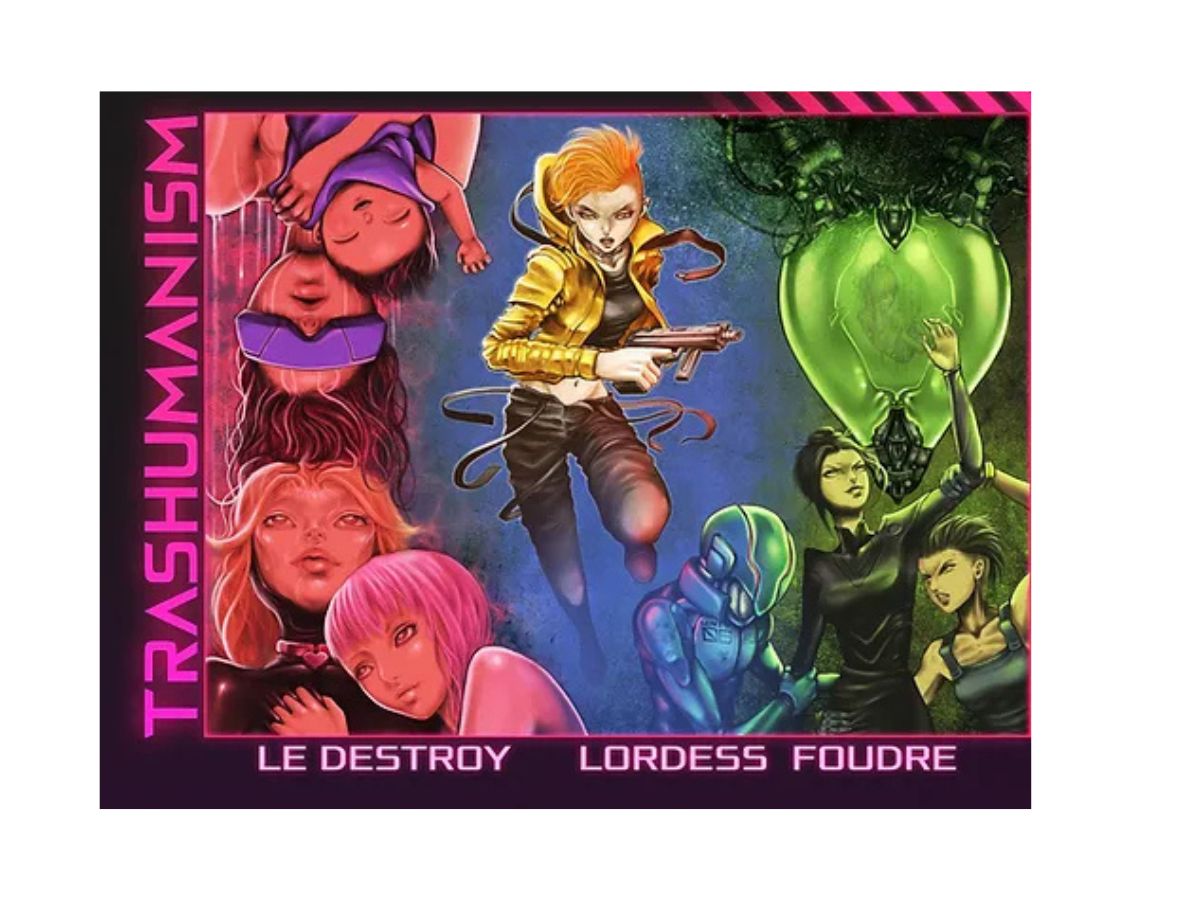
A joint project completed by Le Destroy and Lordess Foudre, the graphic novel translates the music into images, acting as a visual companion. During the panel, Le Destroy explained that translating the album’s three main concepts to the graphic novel helped drive the characters and colors. During the panel, she explained, “Some of the characters are more rebellious, and they’re really fighting for people. And so we leaned on things like blues and reds. You know, you would expect a lot of red when you’re going to battle, going to fight.”
She continued to explain that art is important, not just a luxury, which defined their decision not to release the book digitally:
“I’m just not going to do that with this. It is physical only because it’s really special. It’s meant for you to live with it and hold it and be with it and experience it and turn pages and spend time with it. It’s a really beautiful hardcover art book so you can experience the world.”
And beautiful it is. Responding to questions about the collaboration process, Olson explained,
“When I was writing the panels, I saw things a certain way, and I would try to describe them like from a director’s chair, where you want the cameras angled. Sometimes I would be seeing something a certain way and describing it, but then she did something completely different, where the viewpoint was different than what I envisioned. And so, unexpected surprises, which I love.”
The narrative centers on a future world where DNA is a commodity, with synthetic humans and robots interacting with biological humans. As science siphons people’s essence and autonomy, different characters across this world live in it, revel in it, and love—or seek to find love—in it. Hypercolored imagery in shades of pink, purple, green, and blue splashes across the pages, but the words primarily remain in the music.
The colors go beyond evoking emotion. They are integral to the narrative itself. Scenes depicting the “scientific” experiments are washed in a bright green, reminiscent of the green text in a command line interface. Simultaneously, the green chosen to represent science and technology sits in contrast to viewing the color as representative of nature, especially when the characters are using technology to subvert nature.
A Whole Greater Than the Sum of Its Parts
As Olson explained, the album sits as the underlying narrative for the graphic novel. The story is one of images, with only a few textual elements inserted purposefully.
Sitting quietly with the graphic novel, I slowly poured over each page. First, I took in the whole page, then drilled into the individual images, and then pulled back to a whole page view before moving to the next page.
As someone who ingests visual information quickly, I found that listening to the album while turning the book’s pages meant that I would finish a “chapter’s” story before the song was completed. While I didn’t have the experience of synching up my visual and audio experience perfectly all the time, the moments when they aligned created a unique sensory experience that expanded beyond one medium or the other.
Handling the pages, staring at the images, digesting the lyrics, and emotionally resonating with the music itself created an experience that we don’t have often. Engaging three of my senses—touch, hearing, and sight—tickled my brain. If you add that delicious “new book” smell to the mix, I was engaging four of my senses. The moments where all of them coalesced at once was a heightened sensory experience similar to an amusement park ride but without having to leave my couch.
A Present and Future Anthem
The album has become the background soundtrack to my life. Perhaps the sign of this album as a modern-day anthem is that “Autonomy” blasts from my car’s speakers as I drive to and from a million errands and soccer drop-offs so that every car stopped at the lights with me can hear me belt out:
“It’s my biology / not your technology
Where’s the autonomy / you are the enemy.”