

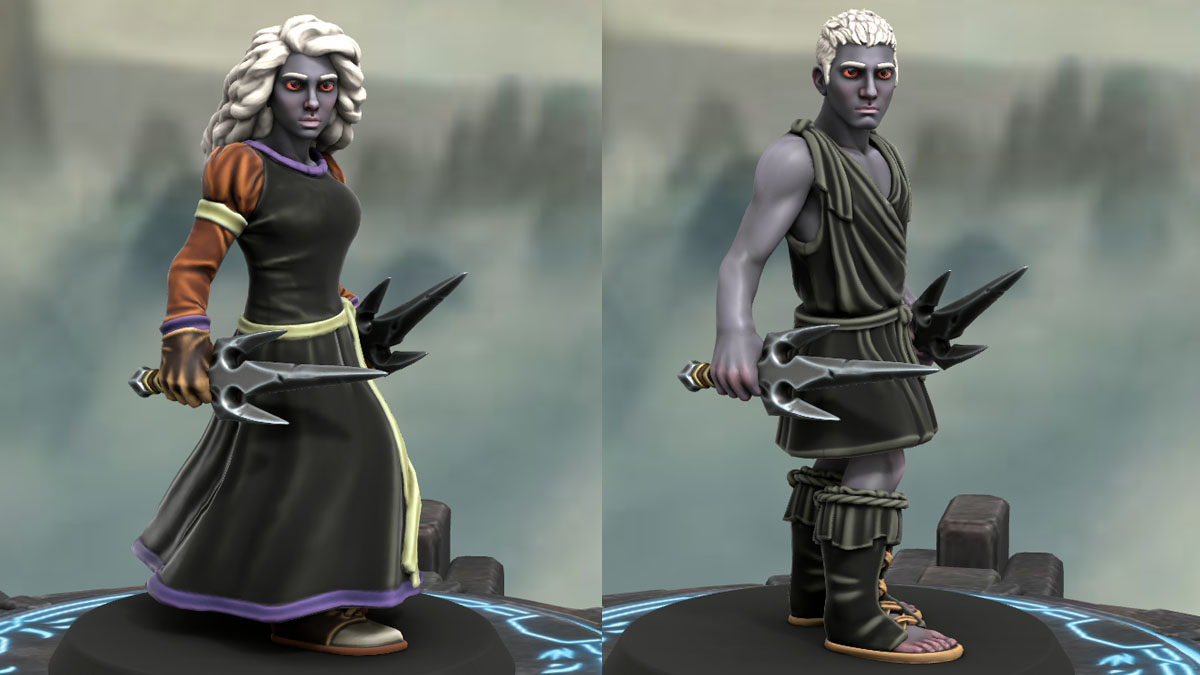

Have you ever considered playing a character in Dungeons and Dragons who has a different gender than your own, is trans, or is nonbinary? This guide will help you find the species, class, and creature options which can bring those identities to life. I would like to note, however, that if you are not trans or nonbinary, this should be done with sensitivity and respect. As a nonbinary player myself, there is nothing I find more disruptive to my enjoyment of a game than a character who only serves as an excuse to make fun of queer experiences. That said, playing a character who is unlike your own identity is a core part of roleplaying games, and can lead to deeper understandings of others. Read on to see how your character’s species, gear, and other features can help you bring a trans or nonbinary character to life.
Note: You do not have to be trans, nonbinary, or even a member of the LGBTQIA+ community to play a character who fits one of those descriptions. That said, if you are an ally, do your best to be open to feedback from your LGBTQIA+ community members if they tell you something about your portrayal is problematic. It’s not a criticism of you, it’s a moment for learning, together. Many people roleplay characters unlike themselves to learn and experiment, and that’s the magic of TTRPGs. We just all have to be mindful that there are real-world reflections of those characters in the people we know, and we have to do our best to take care of their needs, too.

Species
When considering a trans or nonbinary character, an easy place to start is with species (formerly known as race). This is because species is such a central part of a character’s identity in the game, and the species may have specific rules about gender roles already embedded within its lore. Our character’s species can determine height, weight, lifespan, and much more. That said, any character species can be played as a trans character. If you’re interested in dipping into a race with gender-variant lore, you might want to read about warforged, changelings, fae, and elves.
Warforged, the Consummate Agender Species
As a newly-created species, the warforged are the baby race of Eberron. They were typically created without gender-indicating features, and every warforged is free to identify with any gender or none at all. By default, warforged are assumed to be gender-neutral, as they do not have biological sex, culture, or history to inform their gender identities the way other races do. A warforged might prefer male or female pronouns, or may prefer they/it pronouns. There is no wrong answer here, making warforged the easiest race to play as nonbinary or having no gender at all.
Changelings, the Genderfluid Adepts
Changelings also hail from the war-torn world of Eberron. Possessing the ability to turn into any person or appearance they like, including physical anatomy, changelings are poised to be the easiest race to play as genderfluid in the worlds of Dungeons and Dragons. Able to shift from feminine to masculine as easily as changing shirts, changelings are never pinned down by presentation. Because of this ability to morph from form to form, and a culture of adapting one’s behavior, mannerisms, and overall presentation to match their current form, changelings have long been played as a race with little personal attachment to gender roles, except as they find them useful.
Fae Species, Inheritors of Chaos
There are a number of fae creatures (as described in Mordenkainen Presents: Monsters of the Multiverse) which can be played as character species, including satyrs, fairies, and centaurs. Due to their connection with the Feywild, the unexpected is, well, expected in their presence. Meeting a fairy or satyr is already an exotic experience, so who would bat an eye at a member of the fae species whose identity, presentation, and anatomy are at odds? While there are no canonical sources providing rules or mechanics for this, these species fit easily into the “trickster” or “unpredictable” archetypes. Maybe your character is a mercurial fairy who shifts from one presentation to another at a thought, or a satyr who finds joy in everything, regardless of gendered expectations. The fae folk have long been a part of human lore as those with exceptional abilities, and there’s no reason they can’t be the same in your games.
Elves, Born of Corellon
You may find elves to be a surprising entry here, but thanks to Mordenkainen’s Tome of Foes, we have a well-detailed origin of the elven race as having been genderless or genderfluid, in the image of Corellon, their patron deity. In this work, the elves are described as having the ability to change their form at will, and losing that ability in the pursuit of power. But that isn’t the end of the story. Those who are blessed by Corellon might have exceptional talents, a boon offered by a god(dess) who is still moved to help their progeny. Corellon is described as follows:
“A being of consummate mutability and infinite grace, Corellon was a god like no other — able to take the form of a chuckling stream, a teasing breeze, an incandescent beam, a cavorting flame, or a crackling bolt of lightning. On nothing more than a whim, Corellon’s body could become a school of fish, a swarm of bees, or a flock of birds.”
With a creator deity so well known for their changing form, a trans nature is an easy fit for devotees to Corellon, whether that devotee is a priest, druid, or lay worshiper. Elves also have the most diverse forms in all of Dungeons and Dragons lore, including wood elves, drow, eladrin, astral elves, and sea elves among others. With a species capable of changing its fundamental nature to match their environments, it naturally follows that individuals may be able to change their appearance, behavior, and physical features to match who they know themselves to be.

A Cornucopia of Species
It’s important to remember that, just like real-world humans, any character can be a member of the LGBTQIA+ community. Trans people are everywhere, even in species and communities with strict gender roles. When creating a character of other species, especially those without the ability to change their shape, think about how your character might present to communicate their gender identity with others. Here are some examples for the 10 species which will appear in the Players Handbook (2024).
- Aasimar—Trans folk may communicate their identity through changes in clothing, jewelry, and hairstyle. Aasimar are human-like, but their features vary widely, so generic descriptions won’t get you too far.
- Dragonborn—With few gender-aligned physical traits, dragonborn might wear armor or wield weapons which distinguish gender, or they might exercise with a specific ideal in mind. For example, female dragonborns are more muscular/bulky than males.
- Dwarf—A male-to-female trans dwarf might shave her beard or use different braids in her hair to communicate a female identity. A nonbinary dwarf may wear a beard or not.
- Elf—As discussed above, you might have the ability to change your form. Elsewise, clothing, hair, and mannerisms may be prominent indicators of gender.
- Gnome—Gnomes are known for their brash and compulsive nature, a trans gnome might not make external efforts to match their gender identity.
- Goliath—The goliath species is known for its meaningful tattoos, so a trans goliath might alter or add to their tattoos to convey their gender identity.
- Halfling—A trans halfling adventurer may be prone to blunt-but-friendly corrections, rather than altering their appearance, relying on others to respect their identity as stated instead of visual cues.
- Humans—As in our world, humans have as many ways to communicate their identity as there are people. Clothing, hair, makeup, and countless other features can be used to share their identity. Be creative!
- Orc—With orcs joining the core lineup, it’s important to think about them more complexly than we have in the past. Trans orcs might use any means to convey their identity, but the way they trim or decorate their tusks might be one method.
- Tiefling—These infernal siblings to humans are marked by their demonic features, but you don’t have to stop your description there. Describing how your tiefling cares for their horns, tail, wings, or claws can help bring your character to life.
Gear, Armor, and Weapons
An important part of how your character is perceived is going to be in what they wear. Do they have tailored clothing or something bought from a vendor? Is their weapon an heirloom or just a tool to do the job? Making intentional decisions about your character’s appearance help your fellow players and the DM determine how other characters perceive yours. Are you playing a character like Jessica Rabbit, drawn as a sex symbol, but ultimately only interested in genuine connection? Does your character lean into any gender concepts in particular, like hair styles, gestures, turns of phrase, or performative action (such as flexing, flirting, or otherwise playing into a gender role)? Consider the colors your character would be comfortable wearing, and whether a giant pink sword would gel with their vibe or send the wrong message. There’s not a correct answer here, no matter the identity of your character. What matters is that you, as a player, have given sufficient thought to your character to make it easy to roleplay and narrate in your games.
A piece of advice I give younger players (8-16) or new players is to find a picture that reminds them of their character. This can be a celebrity photo, an illustration from a book, or even fan art. Having a reference point helps them articulate and define the traits their character has. Usually, I find it’s better to find an image that’s close, but not quite it. In narrowing down what features in the image don’t match the character, the player is able to explore and articulate the details of what their character is rather than what it is not. This can be especially useful if you’re thinking about a trans or nonbinary character, because the character may or may not have an ideal appearance for their gender identity. They might or might not be good at telling people who they are, or skilled in presenting how they’d like. These are places where the character might grow or find friction, and those places are the richest garden for growing good roleplaying opportunities.

Tips for All Characters
Whether or not your character is trans, nonbinary, queer, or cis/het, being mindful of how you describe and portray your character can help you bring the character to life for others, and bring richness to your games. Avoid the temptation of describing only your character’s species, class, and personality characteristics. Go a step further, describing how your character hold their tools or weapons, whether they tend to stand in the front or back, and what their first concern is when entering a new situation. A party of murderhobos might roll initiative and think of nothing but combat, but your character may think to check the environment for innocents who could be hurt, or parts of the environment that may be a hazard. When meeting a noble or ruler, does your character nod, bow, offer a handshake, or curtsy? Considering your characters behavior of choice for many situations can help you portray a more dynamic and rich character.
No matter what species or class your character has, there are countless ways to bring their identity to life. Consider these things when creating a trans or nonbinary character, and flesh out your character’s goals, motivations, etc.
- What gender, if any, does your character feel closest to?
- Has your character transitioned? Are they in the process? What do their “transition goals” look like?
- Is your character interested in magical items for changing their appearance, or does that feel fake?
- Is your character trying to alter their physical form with magic, or do they like the body they have?
- What does your character like about their appearance, behavior, and other traits?
- What does your character dislike about themselves, if anything?
- How does your character feel about being misgendered, if that happens?
- How does your character honor their roots or their experiences from before a big change in their life?
- What types of people are likely to catch your character’s eye? Who do they feel drawn to?
- Is your character interested in romance? Platonic intimacy? Friendship?
- Does your character feel like they fit in with their family, community, or party?
- Does your character ever talk about their assigned gender/sex? Who would they talk about their transition with?
Remember, there is no correct way to portray your character, so long as you are doing your best to explore that character in a way that isn’t degrading to real-world people. Make sure to check in with your friends to make sure you’re helping to play an interesting and inclusive game. Finally, remember that your character is always going to be a bit of an extension of yourself, so consider what you have in common with your character along the way.
TL;DR
There are many ways to approach playing a trans or nonbinary character in the worlds of D&D. Experiment, explore, and don’t be afraid to try different ways of expressing yourself. After all, learning who we are and how we want to exist in the world is the core journey of the trans experience. If you are trans or nonbinary or if you’ve played a trans or nonbinary character, please comment, letting us know how you have honored that identity through your characters’ species, philosophy, and deeds.
Disclaimer: Links provided in this article direct to the resources a race is presented in. The author may make a commission on purchases made through these affiliate links.
Click through to read all of “How to Play Trans and Nonbinary Characters in Dungeons and Dragons” at GeekDad.If you value content from GeekDad, please support us via Patreon or use this link to shop at Amazon. Thanks!

