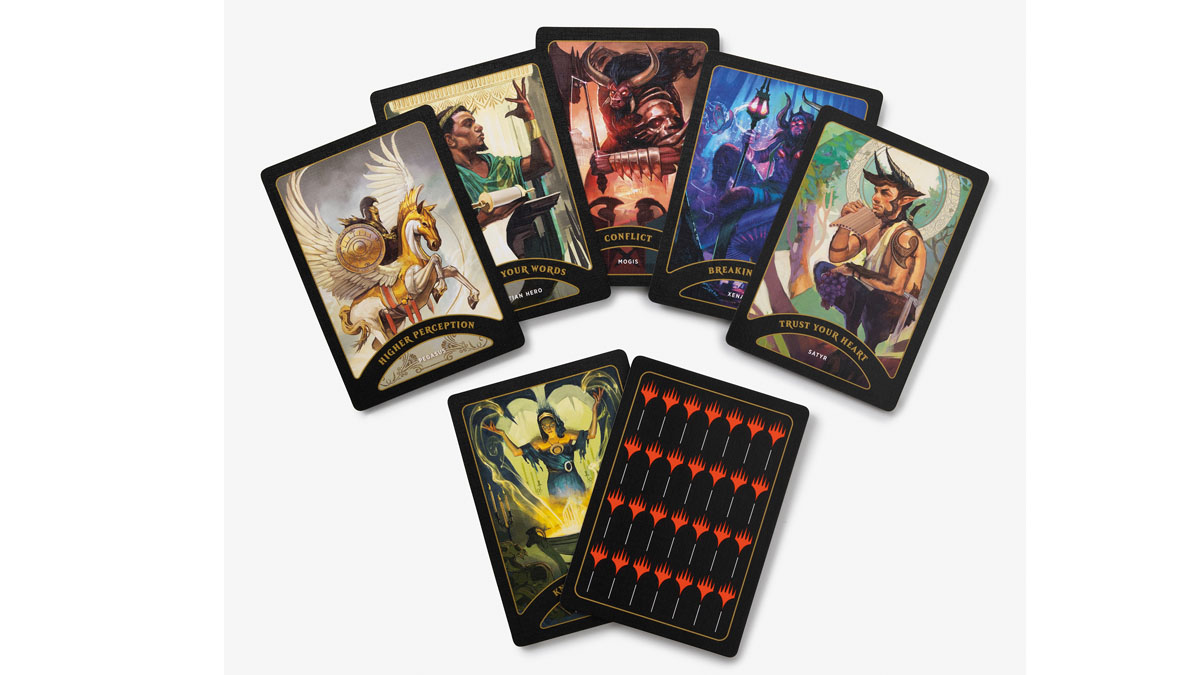

Oracle decks and their cousins, tarot decks, have a long and somewhat legendary history as divination tools, but they can be so much more. The Magic: the Gathering (M:tG) Oracle Deck is an illustrated deck of 52 cards, just like traditional oracle decks. The real difference is in how the guidebook approaches the reading of said cards. As a 20-year practitioner of non-mystical tarot and oracle card readings, and as a mental health and psychiatric skills trainer, this author would like to share their thoughts on the therapeutic uses of this deck, which is on sale for $24.99 beginning today.

What’s in the Box?
The M:tG Oracle Deck includes 52 cards, a guidebook, and a sturdy storage box. Each card features a hero, deity, creature, or planeswalker, illustrated and titled to bring the oracle card’s purpose to life. For example, the oracle card “Creative Fire” features an image of the deity Purphoros prepared to strike an anvil with his hammer. The guidebook describes this card as a prompt for considering whether you’re forging the life of your dreams or letting your internal spark fade. Fans of the trading card game will recognize an abundance of characters featured in the Theros blocks of recent history, mainly Theros Beyond Death.
The Secular Argument
One thing I look for in tools I keep on hand is the ability to use them for non-divinatory purposes. Because I teach therapy skills for a living, I was absolutely chuffed to find the guidebook’s entries to be worded well, and to focus on introspection and reflection rather than providing “answers” of some kind. The introduction guides the card reader to consider positive and solution-oriented interpretations, and each card’s entry has three parts. The M:tG Story entry tells you about the card, while the other two entries—”Card Meaning” and “Reversed Meaning”—offer two ways to consider the card in the context of your reading. While each card is unique, I found them all to be compatible with healthy therapeutic processes. To explore this in-depth, I’ve chosen the oracle card “The Warrior” to dissect.

The card presented for “The Warrior” features the centaur warrior-god Iroas standing over a gladiator in an arena. The guidebook gives us the story background for the card: “Iroas is the god of victory and warriors. He represents our indomitable will and determination to overcome any obstacle.” This is a strong start, because it’s short, sweet, and inclusive. It doesn’t say that some people have an indomitable will or determination, it says he represents “our” indomitable will and determination. If the reader of this card wants to stop there to interpret the card at that point, they can, and it sets them up for a healthy interpretation.
The Card Meaning entry states: “There are times where we must bring forth the Warrior—whether it is to discipline ourselves to accomplish a task or to stand up for what we feel is right. Let go of any excuses and find the warrior within.” This take is very compatible with the teachings of mindfulness, intentionality, and willingness which are central to many psychotherapeutic approaches, especially those that help one move from powerlessness to agency.
The Reversed Meaning states: “Has everything become a fight? Is everything scattered? Have you forgotten your inner strength and self-love? If so, get back to what really matters by clearing out any clutter, doing away with negativity, and keeping things simple. A warrior needs focus and discipline.” These prompts are open enough to encourage deeper thought, while still being specific enough to help the reader along.

If I had been handed the guidebook with no M:tG flavor, no illustrations, and no clue that this was a themed set of oracle cards, I would still be thrilled to have it in hand. The text often reads as if it were written by a skilled therapist or experienced skills trainer. If I could give a copy of this deck to each of my clients, with thorough instructions as to how to use it with their Dialectical Behavior Therapy (DBT) skills, I would be thrilled. Sometimes, all we need is a neutral, positive, or just third-party perspective to shake our assumptions up.
Complaints
I try to always find at least one legitimate complaint with a given product, but I truly had difficulty finding something substantial for this one. If I were to nitpick, I’d say that it’s unfortunate that the backs of the cards are both boring and lacking symmetry, which would allow reversed cards and upright cards to be shuffled more anonymously. That said, most of the time you’re looking at the fronts of the cards, so it’s not a significant issue.
TL;DR:
The Magic: the Gathering Oracle Deck is a 52-card deck which functions as a traditional oracle deck, but also can be used as a therapeutic tool for those needing another healthy perspective on their thoughts, concerns, and challenges. It becomes available for sale today, May 21st, and is a very affordable $24.99.
Click through to read all of “A Secular Argument for the ‘Magic: the Gathering’ Oracle Deck” at GeekDad.If you value content from GeekDad, please support us via Patreon or use this link to shop at Amazon. Thanks!