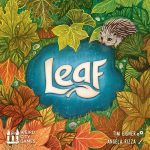
The weather is getting cooler, leaves are changing colors, and animals are preparing for winter.
In “Reaping the Rewards,” I take a look at the finished product from a crowdfunding campaign. Leaf was originally funded on Kickstarter in the fall of 2022, and was delivered to backers last fall (2023). This review is based on my original Kickstarter Tabletop Alert, updated to reflect the final rules and components.
What Is Leaf?
Leaf is a tile-laying game (of sorts) for 1 to 4 players, ages 10 and up, and takes about 30 minutes to play. It retails for $40 and is available in stores now or directly from Weird City Games. There is also a deluxe edition available for $79, and a small expansion, Season of the Bear, available for $15. The game has a family-friendly nature theme and is not too complex, so I think the 10+ rating is about right.
Leaf was designed by Tim Eisner and published by Weird City Games, with illustrations by Angela Rizza.

Leaf Components
I received the deluxe edition and was also loaned a copy of the retail edition for comparison.
Here’s what comes in the retail edition:
- Leaf mat
- Tree board
- Animal mat
- Season marker
- Start Player token
- 32 Leaf tiles
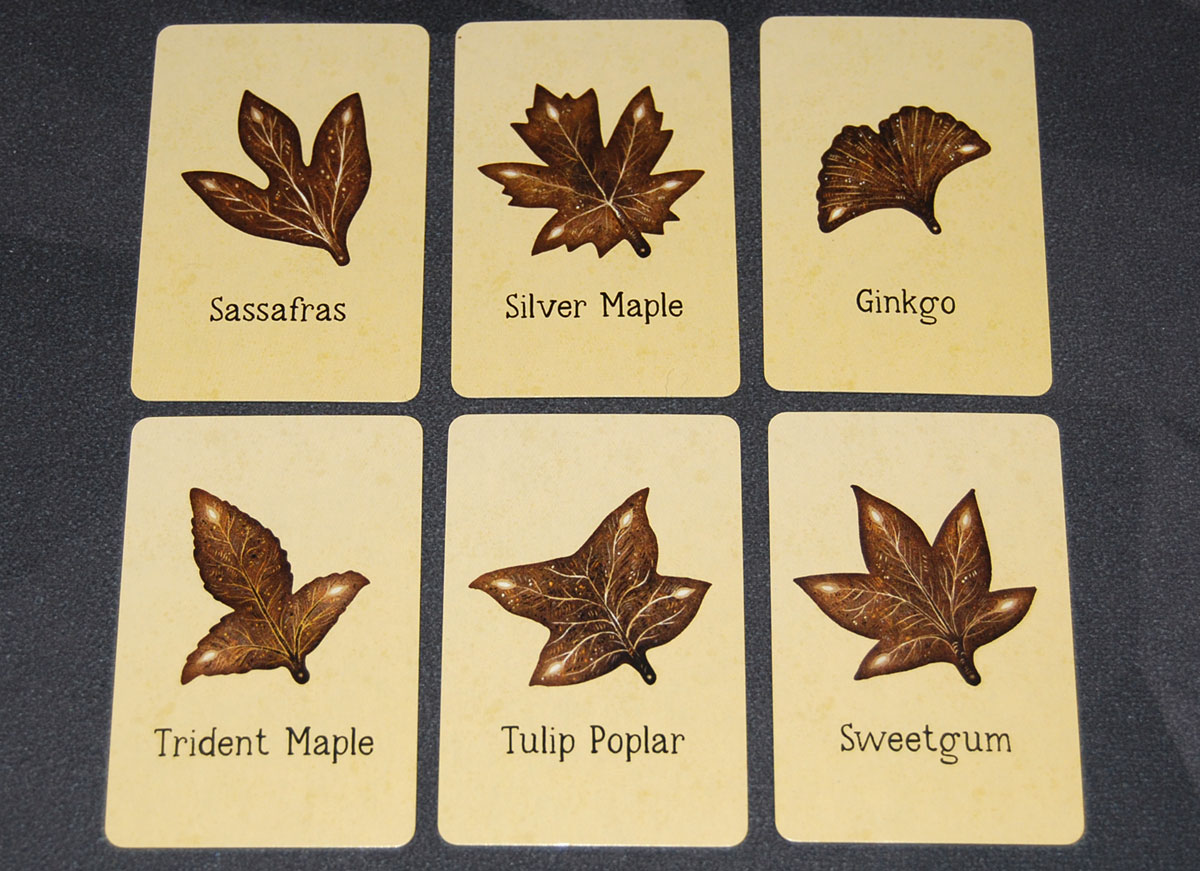
- 36 Leaf cards
- 48 Animal cards
- 58 Acorn tokens
- 25 Sun tokens
- 4 Player mats
- 60 Mushroom tokens (15 per player)
- 4 Squirrels (1 per player)
- 13 North Wind cards (for solo mode)

The leaves and animals are illustrated by Angela Rizza and are colorful; the animals are really lovely and have almost a woodcut illustration quality to them, and it’s a nice fit for the theme. They look like they’d fit in a picture book about preparing for winter. The leaf cards are half-sized cards, and the animal cards are full-sized cards.
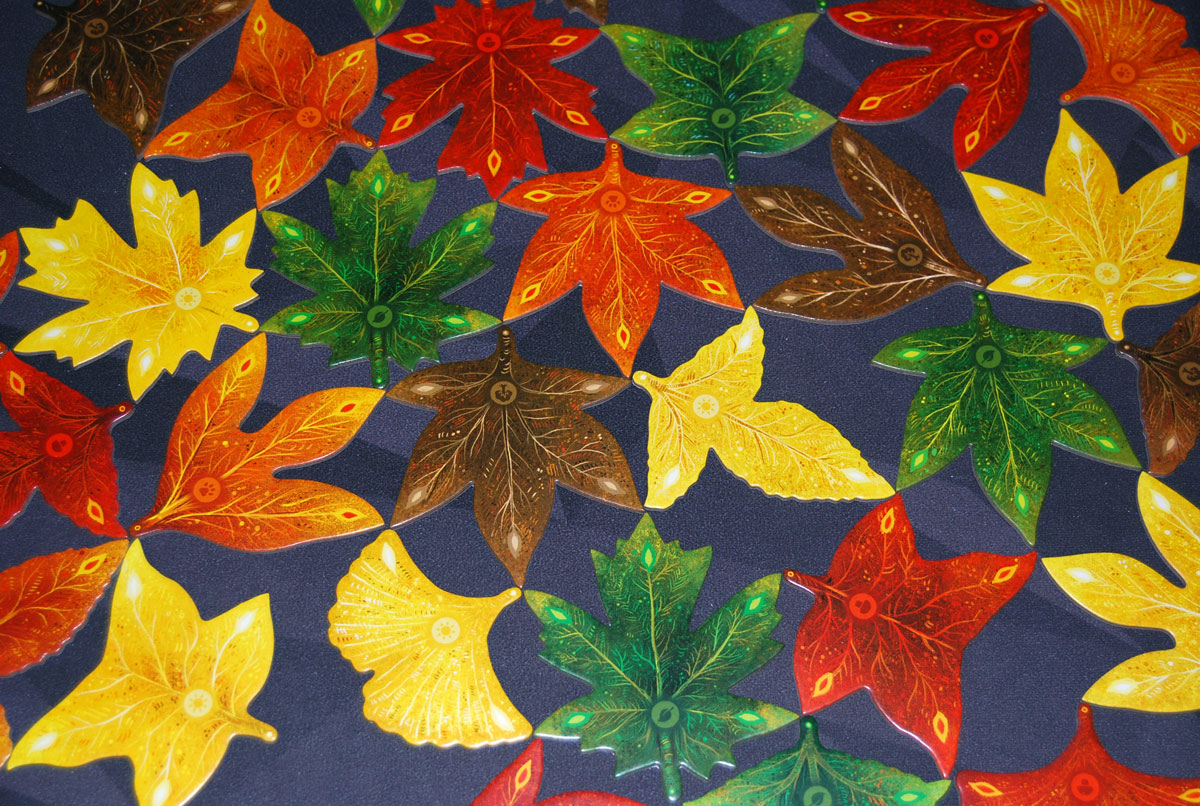
The leaf tiles themselves are maybe about the size of Catan tiles, but actually shaped like leaves. Each leaf shape is based on a regular hexagon, though some of them have some of the vertices removed. This allows for an interesting geometry as you lay out leaves on the table—they can generally be arranged in a hex grid and the various leaf shapes can connect with each other, but those with fewer points can be fit together more tightly in a way that skews the grid, too. Each leaf has a small icon on it as a reminder of the associated action for that leaf color. Leaf looks great on the table, in large part because of these large, colorful leaves.
The animal and leaf mats are cardstock and are pretty simple: just a space to hold the cards or tiles, with a season track across the top of the animal board. The tree board is actually tree-shaped, and it has two paths going up that intersect at several points. The player mats are used to divide your “forest” area from your “winter den” area, and also serve as a player aid, both for the leaf powers and (on the back) for end-game scoring.
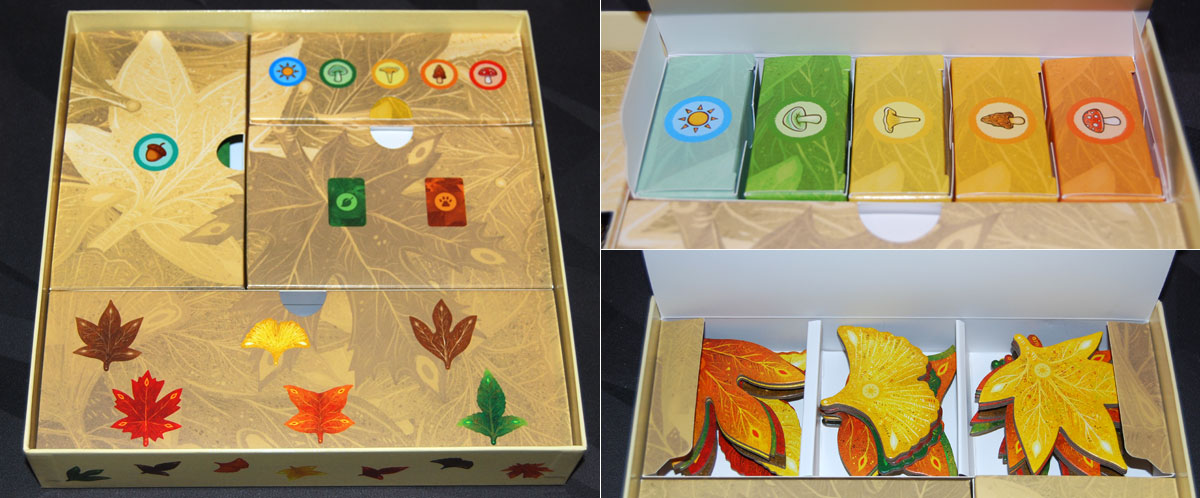
The box itself has little compartments (with icons printed on them) for all of the components, including small tuckboxes for the mushrooms and sun tokens and a paper envelope for the acorns. It’s a nice way to keep everything organized and also reduce plastic—the game included small sticker seals on the sides instead of shrink wrap, and the cards had paper bands instead of plastic wrap as well. Weird City Games has moved toward more sustainable components and Leaf is a good example of one way to accomplish that.

The difference between the retail edition and the deluxe edition is that most of the cardboard tokens in the retail edition are replaced with wooden equivalents. In the retail edition, the leaf tiles and all of the tokens are cardboard except for the season marker and the squirrel meeples. The deluxe edition upgrades the leaf tiles, start player token, acorns, sun tokens, and mushrooms to wood. (Oddly, the negative acorn tokens and the 20-acorn tokens are the same cardboard versions.) The exterior box itself is slightly larger to accommodate the extra thickness, but is otherwise similar.
How to Play Leaf
You can download a copy of the rulebook here. Leaf is also available to try for free on Tabletopia or Tabletop Simulator.
The Goal
The goal of the game is to score the most points by contributing to the health of the forest: growing mushrooms, gathering animals into winter dens, advancing the season, and climbing the tree.

Setup
Place the two starting leaves (marked with a spiral icon) in the center of the play area side by side as shown. The leaf board, animal board, and tree board should be placed off to the side, allowing plenty of room to add more leaves in the center. The acorn and sun tokens are also placed in a supply to the side.
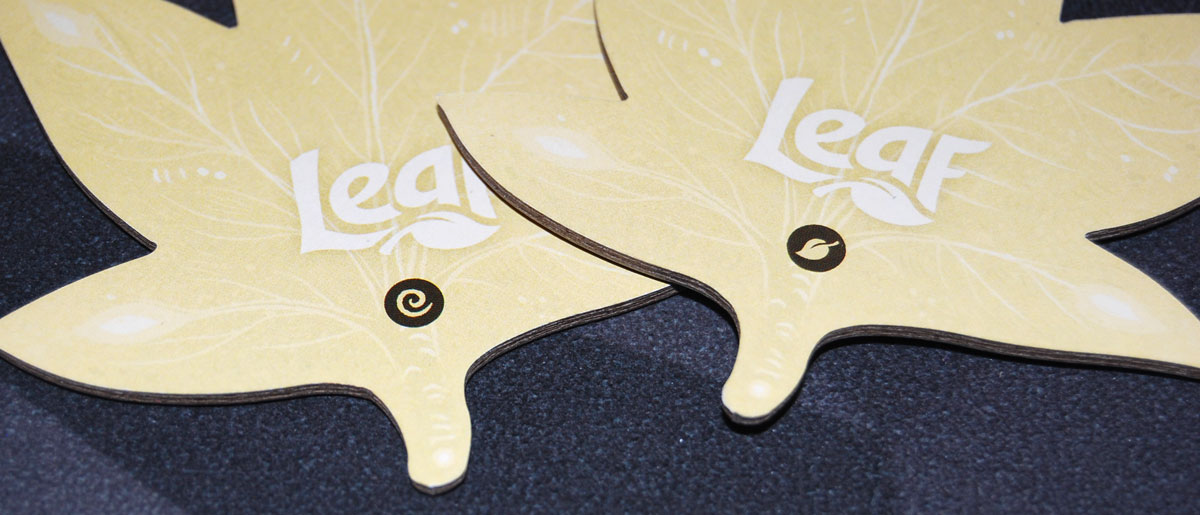
The leaf tiles should be separated by type, shuffled, and stacked onto their appropriate spaces on the leaf board, with the starting leaf (marked with a leaf icon on the back) on top of each stack. Shuffle the leaf cards and deal 3 to each player, and then place the deck nearby.
Turn the animal board to the side for your player count. Shuffle the animal cards and place the deck next to the animal board, and then reveal 5 animal cards on the spaces provided. Place the season marker at the beginning of the season track (based on the player count).
Give each player a squirrel, which goes at the base of the tree board, and the matching set of mushroom tokens. The player who was in a forest most recently goes first and takes the first player marker.
Gameplay
On your turn, you play a leaf card from your hand, and then add the corresponding leaf tile to the forest floor. At least two of the tips (or stem) of your leaf must be connected to the tips and stems of other leaves. (If you have no more cards, you must take a -3 Acorn token and draw 2 leaf cards, and then play. If you play a leaf card that has no more leaves in the supply, you may take the top leaf of any stack.) If you draw the last leaf from a stack, you advance the season marker but do not gain the reward.
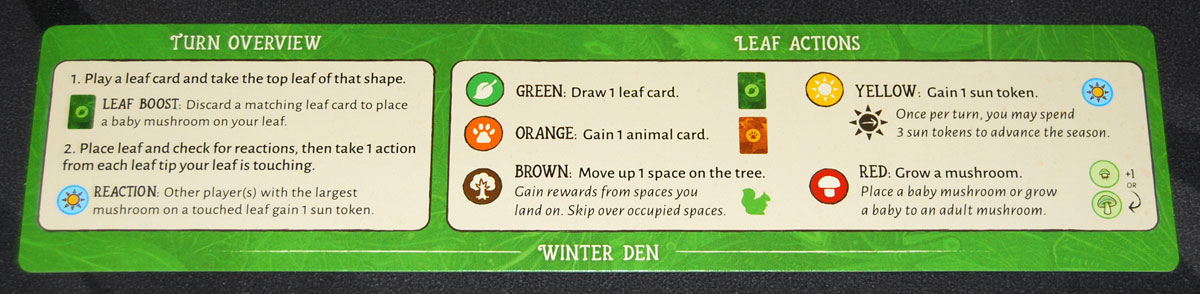
You may play a “leaf boost” if you discard a matching leaf card to place a baby mushroom on your leaf.

For each leaf tip that your leaf touches, you get an action. Note that the color of your own leaf doesn’t matter—it’s only the color of the touched leaf that determines the action.
- Green: draw a leaf card.
- Yellow: gain a sun token.
- Orange: take an animal card (face-up or from the top of the deck), placing it in your forest above your player board.
- Brown: move your squirrel up one space on the tree, skipping over any occupied spaces, and gain the reward you land on.
- Red: plant a baby mushroom or grow a baby mushroom into a full mushroom.
Any number of players may have mushrooms on the same leaf, but each player may only have one mushroom per leaf. When a leaf is touched by another player’s leaf, you gain 1 sun token if you are tied for the largest mushroom on the leaf.

Once per turn, you may spend 3 sun tokens to advance the season marker, which will give you acorn tokens as shown on the track. If the marker passes a frost line, then all players immediately put their largest group of animals into their winter den area below the player board. Note that each group sent into the winter den is separate and will not be combined, even if they’re the same animals.
At the end of your turn, refill the animal spaces on the mat if needed.
Game End
The game end is triggered when the winter line (the last dotted line) is crossed, or when the third leaf pile runs out. Finish the round so that everyone has had the same number of turns before resolving the frost. Then, everyone sends their largest group of animals to their winter dens.
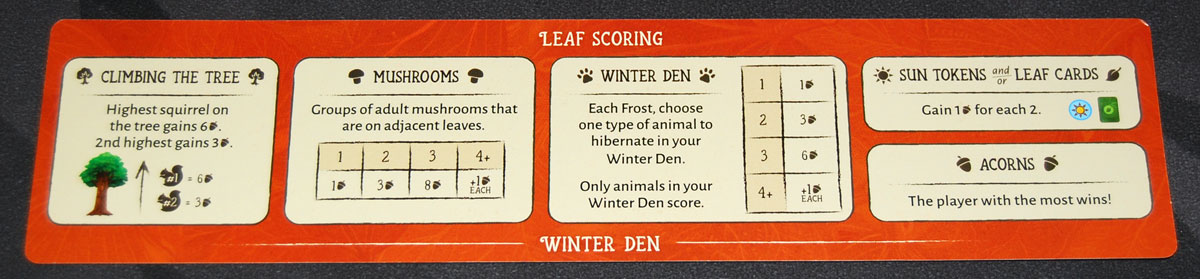
You score points for the following:
- Acorns (collected from the tree, season track, or on animal cards): 1 point each.
- Animals: For each group in the winter den, you score 1/3/6 points for 1/2/3 animals. Each additional animal over 3 is worth 1 point. Animals still in your forest area do not score.
- Mushrooms: For each group of full-sized mushrooms on adjacent (touching) leaves, you score 1/3/8 points for 1/2/3 mushrooms. Each additional mushroom over 3 is worth 1 point. (Baby mushrooms have no effect on scoring.)
- Squirrels: The highest squirrel on the tree scores 6 points, and the second-highest scores 3 points.
- Sun/Leaf cards: Score 1 point for every two sun tokens and/or leaf cards.
The player with the highest score wins, with ties going to the player with the most unplayed leaf cards and sun tokens.
Solo Mode
The solo mode is set up like a 2-player game, and uses the North Wind cards to control the other player. The North Wind cards indicate which leaf the automated player will attempt to play, and what connections it is trying to make. The different color actions are similar to the usual player actions, but with some modifications and a list of priorities for resolving them. You’re trying to score more points than the North Wind, and if you win then you can check off some achievements from the list in the back.
Why You Should Play Leaf
One of the things I love about tile-laying games is the way that you can watch the playing area grow and spread as the game progresses. In many of the games I’ve played, it’s some sort of map, whether the map itself is growing or you’re adding things within an existing map outline. It’s fun to look at the table at the end of the game and see what you’ve built together.
Leaf stands out because of the shaped tiles and the way they fit together—it’s just visually striking, and at first it seems like magic that these different leaf shapes all fit together. (Of course, it’s actually some clever geometry at work, but math can also be beautiful.) Even though the leaves are hexagon-based, the cut-out tiles just give a different impression than it would if the leaves were simply printed on hexagon tiles. Not only that, but it means that some of the leaves with fewer points can fit together on a different grid, which creates strange borders and holes in the leaf coverage.
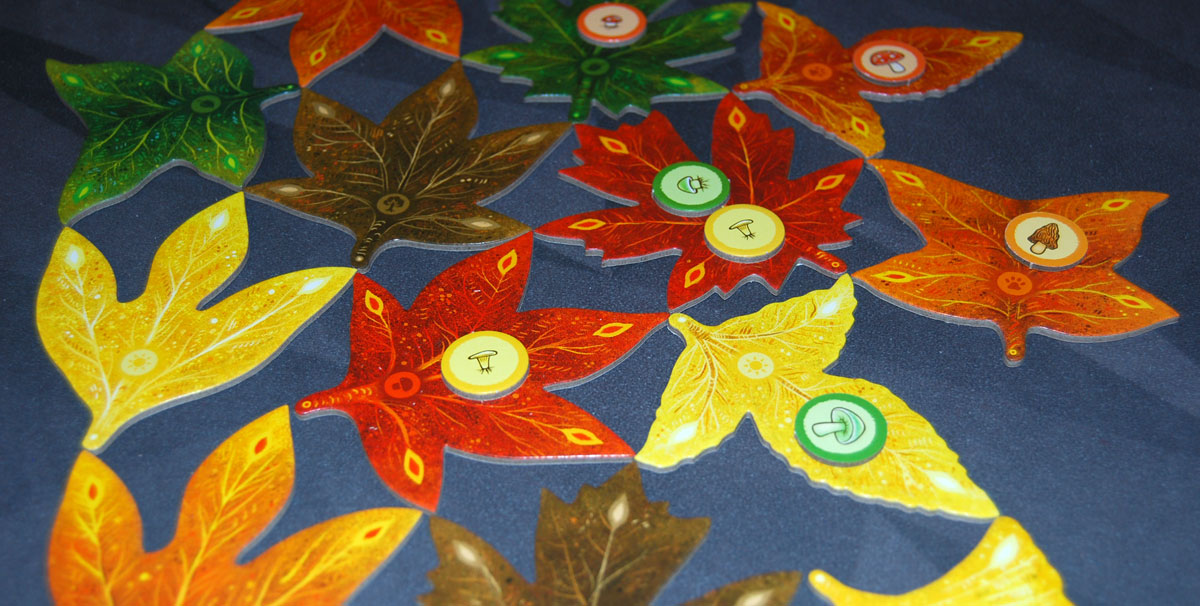
The gingko leaves in particular tend to close off an area, since they only have three tips, and can sometimes be used to close off an area so no more leaves can be extended in that direction. If you’re trying to block access to a particular color, the gingko is your friend!
There are several leaf abilities, but they’re each pretty simple on their own and easy to keep track of. Connect to green when you’re running low on cards, and make sure you hit some orange leaves to collect animals if you think frost is approaching. Climbing the tree is a good way to get a variety of things when other leaves aren’t available, plus you want to stay ahead of the other squirrels for some bonus points.
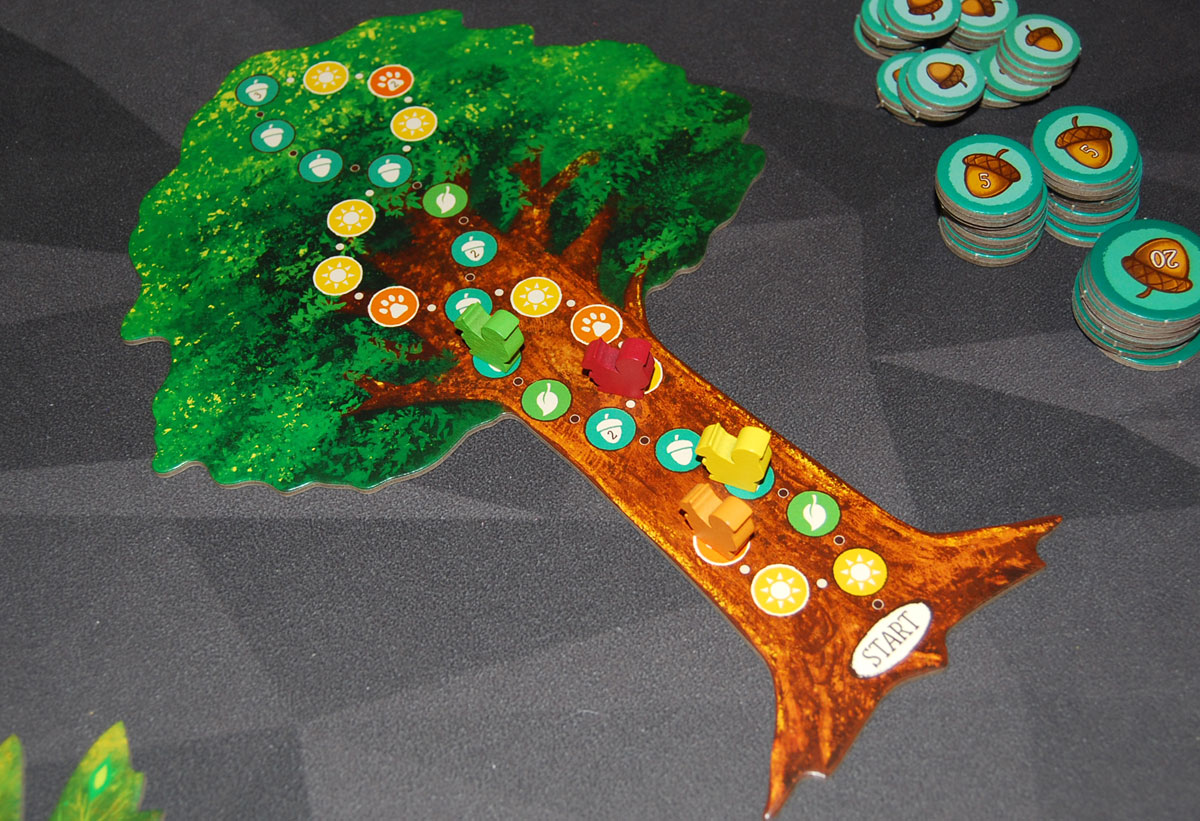
Getting your groups of animals into the winter dens can be a big source of points, and the best ratio is to get 3 animals per group. But the timing can be hard to predict. There’s an incentive to spend your sun tokens to advance the season early on, because you get more acorns for the beginning of the track than the end. However, if you haven’t collected enough animals yourself, you may be reluctant to speed things along despite the few extra points. You also want to keep an eye on how many animals somebody else has—if you can trigger a frost line at the right time, you may be able to prevent an opponent from maxing out their animal score.
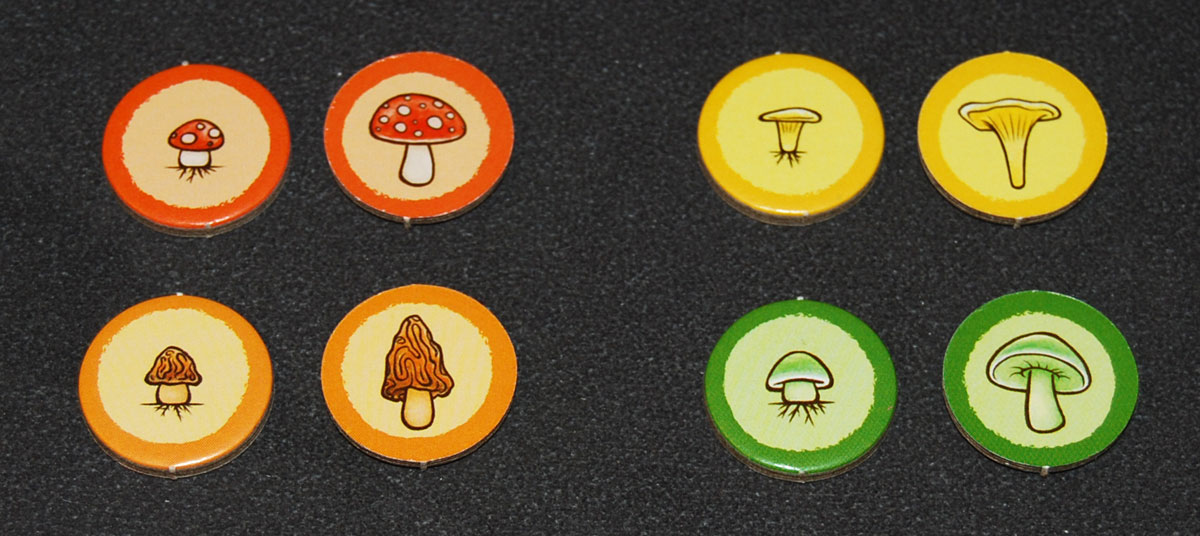
The groups of mushrooms are also pretty valuable—a group of 3 mushrooms is worth 8 points! But getting those mushrooms in place and grown often happens at the cost of something else: you have to spend extra cards, or make a lot of connections to red leaves. (And beware spending too many cards—it’ll cost you 3 points if you don’t have any to play on your next turn!) Even if you plant your baby mushrooms with extra leaf cards, you’ll still need some number of red leaf actions to turn them into full mushrooms. So far in the games I’ve played, we haven’t had a ton of mushroom groups, but they’ve been a significant source of points for the players who managed to grow them.
Weird City Games (which is local to me here in Portland, Oregon) started with a game about ants, and then a game about rainforests. I like the nature theme they’ve got going in their games, as well as their commitment to environmental sustainability by using FSC paper and wood, avoiding plastic, and limiting the box size. Leaf is a refreshing take on tile-laying games with a bit of a puzzly feel, and it’s one that I think families can enjoy together across a range of player ages.
For more information, visit the Weird City Games website!
Click here to see all our tabletop game reviews.
 To subscribe to GeekDad’s tabletop gaming coverage, please copy this link and add it to your RSS reader.
Disclosure: GeekDad received a copy of this game for review purposes.

Click through to read all of “Reaping the Rewards: Fall Comes to Your Table in ‘Leaf’” at GeekDad.If you value content from GeekDad, please support us via Patreon or use this link to shop at Amazon. Thanks!