



Albert Lin has traveled the world unearthing and uncovering sites of ancient civilizations using cutting edge technology. Many of these were previously undiscovered. Now the National Geographic explorer returns with another series on National Geographic, Disney+, and Hulu: Lost Cities Revealed with Albert Lin.
What Is Lost Cities Revealed with Albert Lin?
Our ancient history is full of incredible untold stories of ancient civilizations. National Geographic Explorer Albert Lin is on an extraordinary mission to unlock the secrets of these lost cities and the mysterious people who built them. Armed with technology to strip back the layers of time, Lin experiences personal physical and mental extremes while trekking to some of the most inaccessible and hostile environments on earth – the Mexican Jungle, the deserts of Sudan, mountains of Peru, the forgotten fortresses of Scotland and the remote cave systems of Oman. Lost Cities Revealed with Albert Lin is a documentary series hosted by Albert Lin, who is also a co-producer. The series premieres on National Geographic TV and begins streaming on Disney+ and Hulu beginning Thursday, November 23rd. Let’s take a look at the six episodes in this series.
‘Cradle of the Maya’
Albert Lin is on a quest to discover an ancient lost city of the Maya – once home to the people that built the great pyramid city of Palenque. Equipped with the latest scanning technology, he must hack his way through ancient jungle, swim to the bottom of a dark cenote, and abseil into the heart of a giant mountain to uncover their unbelievable origin story.

‘The Warrior King’
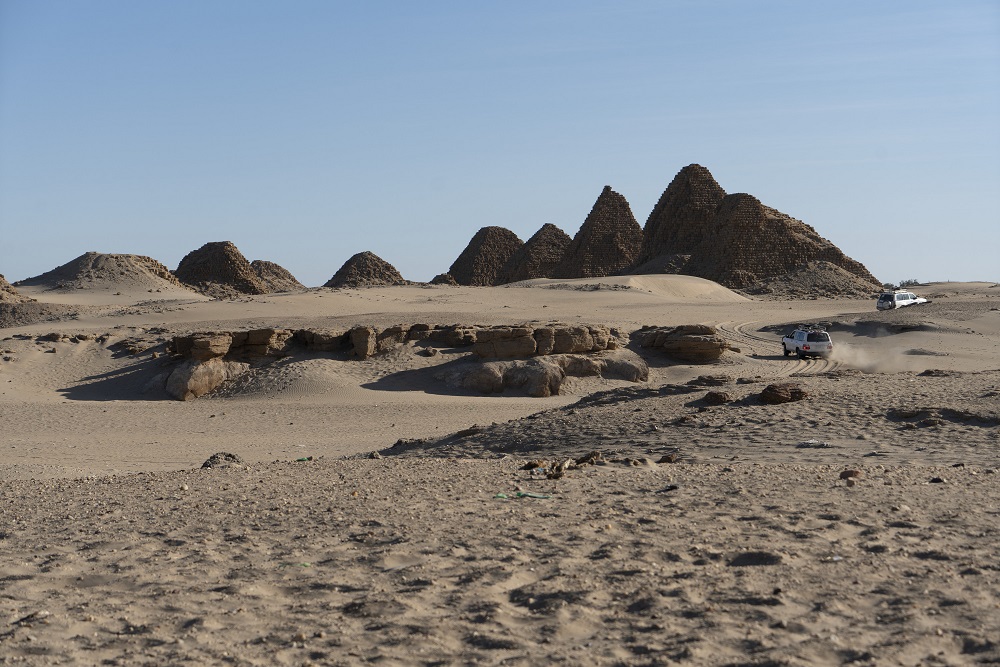
In the remote deserts of Sudan, Albert Lin goes in search of the lost capital city of the Kingdom of Kush, whose rulers once conquered and ruled the ancient Egyptian empire. Armed with scanning technology never previously used for archaeology in Sudan, Albert’s expedition takes him to a flooded tomb beneath a 2,500-year-old pyramid and a sacred mountain believed to be the birthplace of the gods.
‘The Cloud Warrior’
Explorer Albert Lin searches the Peruvian Andes for the lost Chachapoya kingdom, a forgotten civilization in the clouds, that ruled for nearly 1,000 years before being conquered by the Inca. Albert’s expedition will take him from raging rapids to the dense cloud-forests of the Andes, using his extraordinary tech to reveal the lost world of the Cloud Warriors.

‘The Barbarian Kingdom‘
It’s the first century AD and the Romans dominate much of the known world, but their plans to conquer Scotland are foiled by a band of barbarian insurgents called the Picts. Explorer Albert Lin scales sea cliffs, explores caverns, swims rapids and uses high-tech scanners to discover a lost kingdom that may reveal how the mysterious Picts pulled off one of the greatest military upsets of their time.

‘Rise of the Canaanities‘
Explorer Albert Lin searches Israel for the lost city of the Canaanites, a mysterious civilization which survived a biblical era, climate apocalypse. The expedition takes him scuba diving for 4,000-year-old shipwreck treasure and through a terrifying incident on a crumbling cliff face. Using extraordinary tech, Albert reveals a spectacular maritime world built by these ancient climate survivors.

‘Miracle in the Desert‘
Explorer Albert Lin tackles the deserts and mountains of Oman, exploring the legendary lost land of Magan, a forgotten Arabian civilization of the Bronze Age whose precious exports supercharged the most powerful empires. Albert abseils into vast desert chasms, walks among/explores remote clifftop tombs, and uses cutting-edge technology to unravel the mystery of this extraordinary lost world.

An Interview with Albert Lin
I recently had the opportunity to interview Albert Lin about his upcoming series. He shared that he is heavily involved in the process of picking which sites to explore. Over the years, he has created relationships with many archeologists and as they come up with situations where Lin’s technology team could be of use, he leads the team to their location. He was sure to give credit to the people who have already been studying these sites for years and have set the stage for Lin and his team to come in and help them take the next step. An example of this was in Sudan as they were exploring around a temple of the Kush. Albert said that the current archaeologists who were working on this site knew there was a temple and related buildings. However, as Albert’s team used ground penetrating radar, they were able to find evidence of not a small village, but a capitol city of this empire that at one time ruled all of Egypt. He was fascinated that you could see neighborhoods and alleyways where these ancient people lived, that had literally been lost to the sands of time.
After I asked him how long they were at each site, Albert described that they use a leapfrog process. First he sends a couple teams to see what is on the ground and what will be needed. Then the tech team arrives. Though the episodes do not show it, scanning an area with LIDAR and ground penetrating radar can take a lot of time. In fact, he says every time they film these episodes, the tech team goes right up to the last second, often staying up all night processing the data so they are ready for the big reveal at the end. Throughout the process, they are partnered hand in hand with the archeologists. Altogether, they usually spend about a month at each site. Albert also shared that there is an element of risk each time. They are not sure if they will be able to make a big discovery. Yet each time they are able to find something previously undiscovered.
Yet the risks can be even greater than not having a discovery. Sometimes the risks can be life-threatening. Albert described that while filming the episode ‘The Cloud Warriors’, they had to raft along the headwaters of the Amazon River. While going through some rapids, one of the rafts capsized, they lost all of their equipment, and one of his friends almost drowned. They had to regroup, get more equipment, and then come back later to finish. Albert shared that this experience, and others like it, has a profound affect on him. This was not just entertainment, but actually became a quest for him and his team as they put their lives on the line for something very important. He explained that growing up, exploration was all in the past in black and white photos. However, he has learned that there is still a frontier of exploration that continues. As you pick up a piece of pottery with fingerprints from someone thousands of years ago, you are connecting to them through time. The continuum of knowledge is expanding. I liked how he compared his discoveries to finding lost knowledge. When the ancient library at Alexandria was burned, so much ancient knowledge was lost. Now they are rediscovering it, piece by piece.
My final question for Albert was if he could go back to one location from this series, where would he go. He responded quickly that he would like to go back to Mexico to explore more about the ancient Mayan city. During this episode, ‘Cradle of the Maya’, they found clues to a mythical Mayan origin city in a tomb of an ancient Mayan leader. This origin city was thought to be only a myth. However, as they put together the clues, they actually found the city and it was just as the clues described. It was like an Indiana Jones movie but in real-life. As they used LIDAR to scan the area, they found a city around this temple built into a mountain. In fact, they discovered pyramids with a triangular base rather than a square, unlike they had ever seen before. Seeing this early city from the beginnings of the Maya was just incredible.
I am grateful for Albert Lin taking the time to talk to me. We only had 10 minutes, but I could have talked to him for hours. He was just as fascinating one-on-one as he is in the series.
Why You Should See Lost Cities Revealed with Albert Lin
I have enjoyed all of Albert Lin’s other shows he has led for National Geographic, many of which are streaming on both Disney+ and Hulu. Albert has a PhD in science and engineering and is able to use these skills as well as his fascination and study of ancient civilizations to help bring these lost peoples out of the darkness and into the light. Each episode in the series is interesting and engaging, keeping your attention right to the end and the final reveal of what the team has discovered hidden under the ground or beneath the jungle canopy. As a history major and teacher, I love learning about civilizations with which I was previously unfamiliar as well as gaining new knowledge and insights on peoples whom I had studied in the past. In addition, I find it fascinating as the descendants of these once great civilizations who still live in those areas learn more about their past and can take pride in the accomplishments of their ancestors. If you have seen any of Albert Lin’s Lost Cities shows, then you don’t want to miss this one. Even if you have never seen any of these shows, I highly recommend Lost Cities Revealed with Albert Lin as a great place to start.
Be sure to watch Lost Cities Revealed with Albert Lin when it premieres on National Geographic TV and begins streaming on Disney+ and Hulu beginning Thursday, November 23rd.
Click through to read all of “‘Lost Cities Revealed with Albert Lin’ Uses Technology for Archeology” at GeekDad.If you value content from GeekDad, please support us via Patreon or use this link to shop at Amazon. Thanks!


