

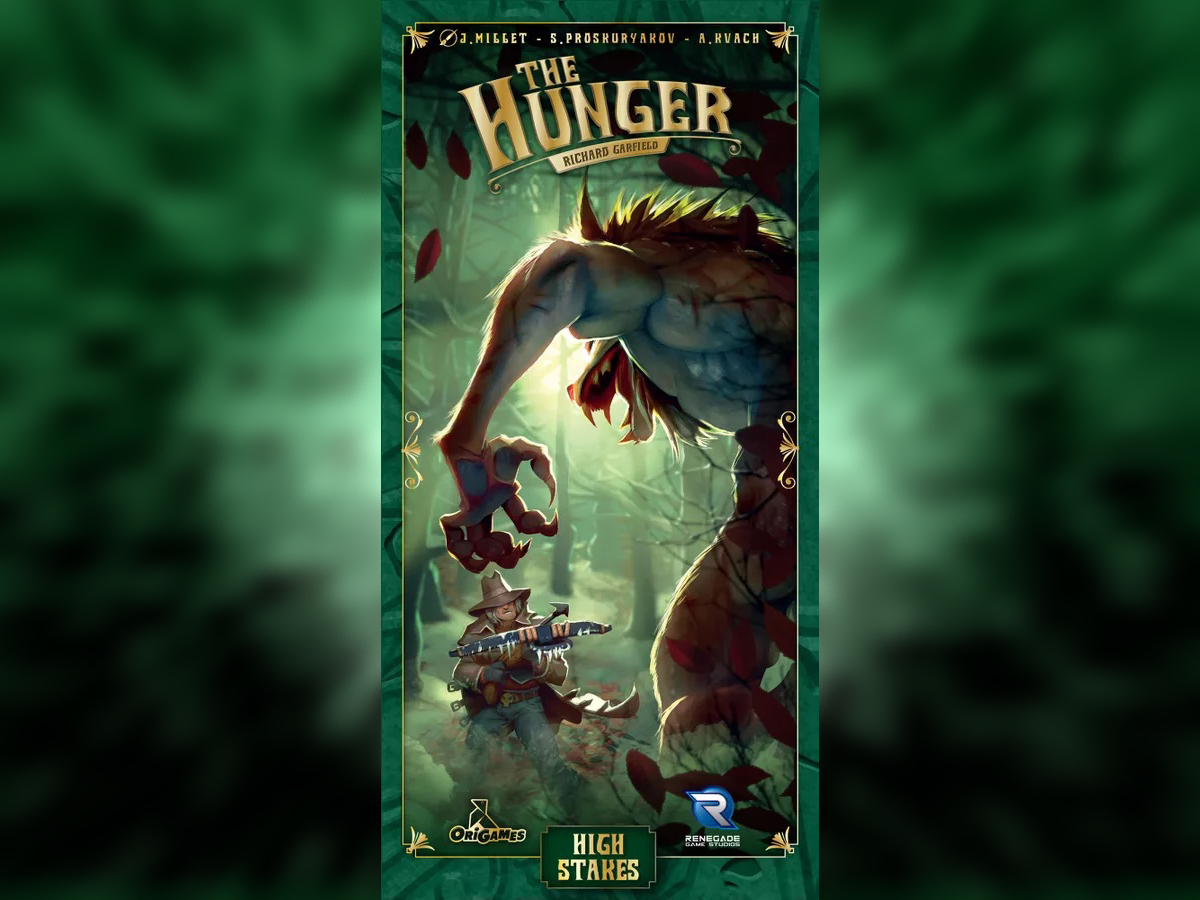

The Hunger: High Stakes brings bigger risks and bigger rewards for the vampires!
What Is The Hunger: High Stakes?
The Hunger: High Stakes is an expansion for The Hunger, a deck-building game for 2 to 6 players, ages 12 and up, with a playtime of about an hour. (You need a copy of The Hunger to play this.) It retails for $30 and is available in stores and directly from Renegade Games. The base game was a bit more caricatured, making the game as silly as it was spooky, but some illustrations in the expansion (such as the werewolves) can be a bit more intense, so you may want to preview the cards if you’re planning to play with younger kids.
The Hunger: High Stakes was designed by Richard Garfield and published by Origames and Renegade Games, with illustrations by Jocelyn Millet, Semyon Proskuryakov, and A. Kvach.
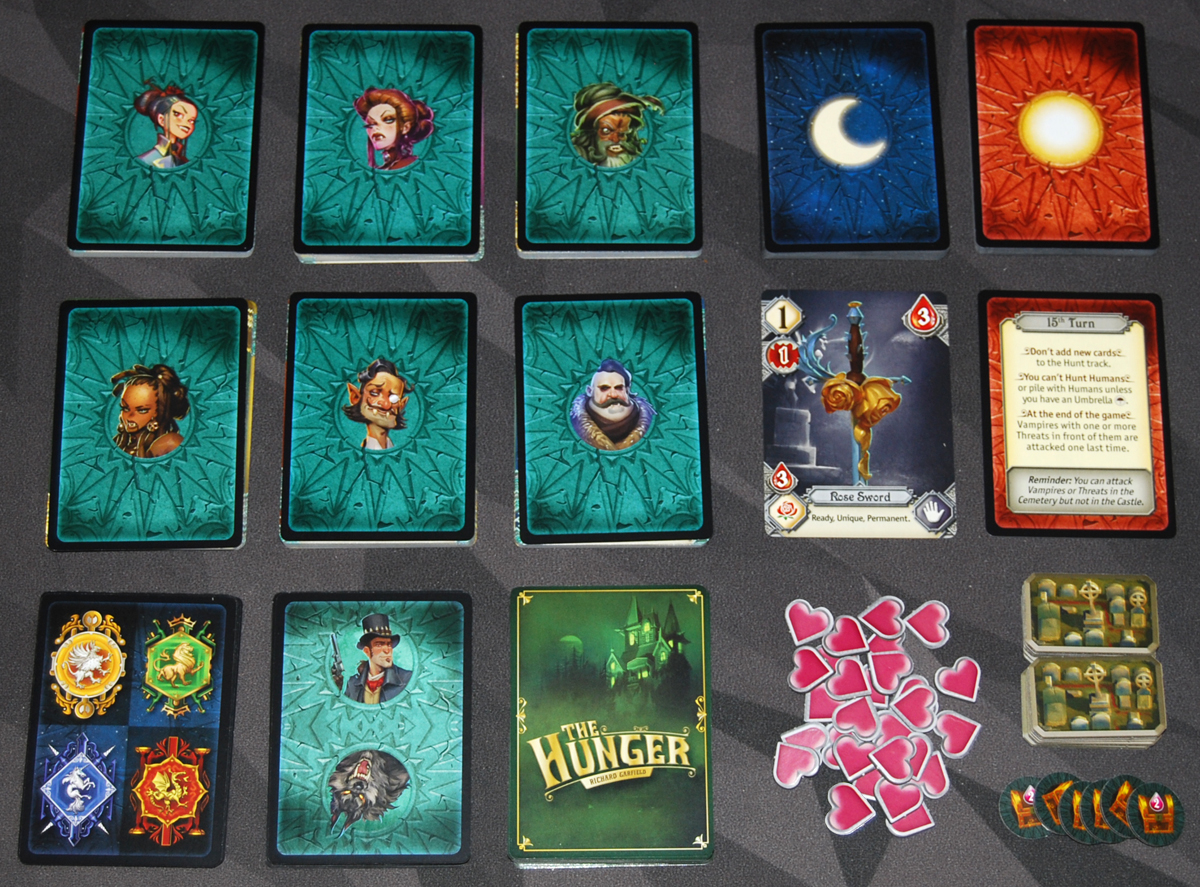
The Hunger: High Stakes Components
Here’s what comes in the box:
- 6 sets of player cards, each including:
- 1 You Are Injured card
- 8 Wounds
- 6 Starting cards
- 20 Turn Event cards
- 15 Game Event cards
- 15th Turn card
- Rose card
- 9 Spawn Location cards
- 16 Threat cards
- 28 Hunt cards
- 28 Damage tokens
- 10 Mission tiles
- 6 Bonus tokens
As you can see, the expansion mostly adds a lot more cards—the hunt cards will get shuffled into the main deck, but there are a lot of new types of cards that will be used in new ways. Since I’ll show more details about the cards in the How to Play section, I won’t spend too much time digging into them now.
My primary gripe about the new components that get mixed in with the base game is that they are not marked in any way to indicate they’re from the expansion. The new types of cards—wounds, events, threats, and a few others—are obvious because they simply don’t exist in the base game, but the mission tiles and hunt cards that get shuffled in are a lot harder to separate out. Some cards can be identified because they have new icons that weren’t in the base game, but that requires looking carefully at each card individually. Since it’s not recommended to use the expansion if it’s your first time playing, this means that once you mix things together, it’ll be harder to introduce new players to the game. It’s always nice to have some sort of icon or marking on expansions—particularly if there are more expansions in the future, so you can tell those apart as well.
The new components do fit into the base game box, just barely—I moved the base game’s starter cards (the only components from the base game that you won’t need for the expansion) under the insert, and then the rest of the cards fill the three card wells. The space for the mission tiles was designed exactly for the base game, so I tossed the extras in the little well below the player sheets.
How to Play The Hunger: High Stakes
You can download a copy of the rulebook here. For how to play the base game, please refer to my original review. I’ll go over what’s new here.
Setup
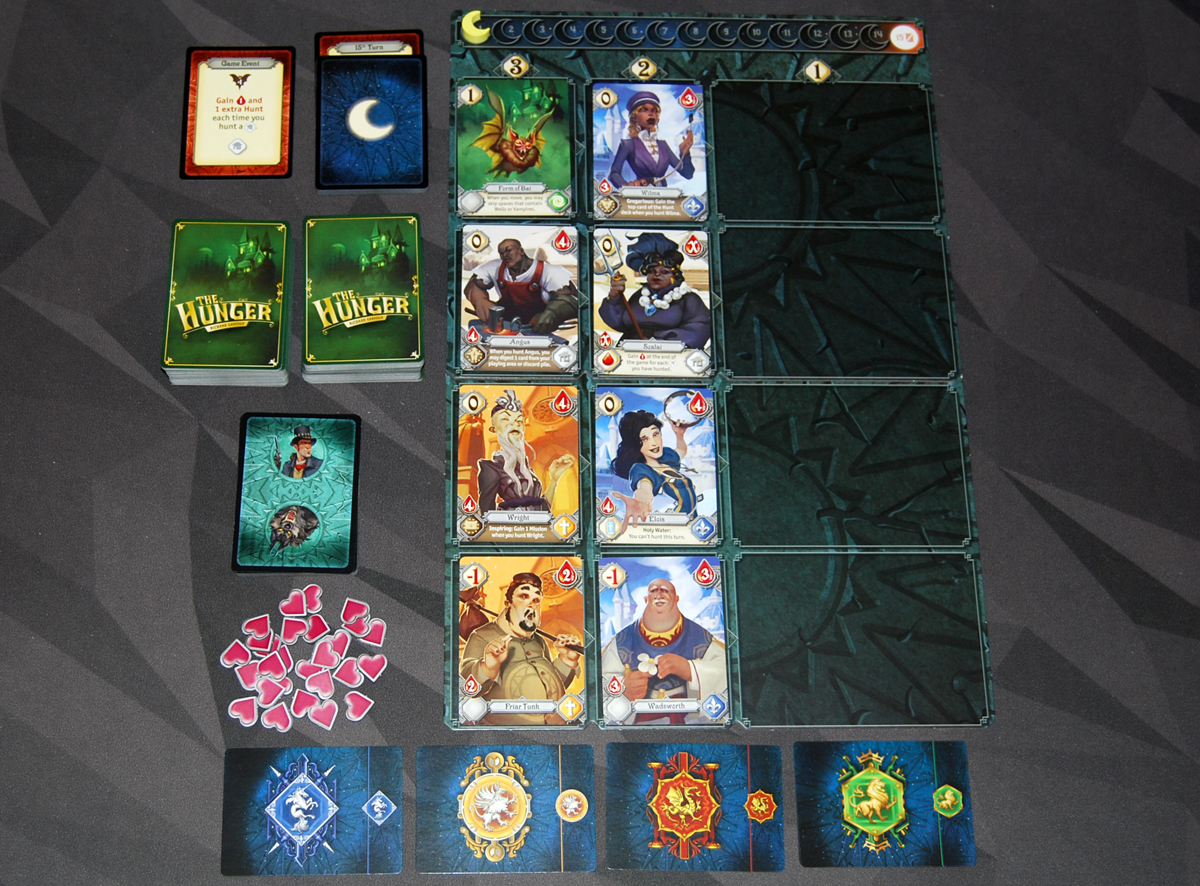
You still use most of the setup from the original game, but toss the player starting cards and use the new High Stakes starting cards for the players. Each player also gets their You Are Injured card along with 8 wound cards stacked on top of them.
The new bonus tokens, mission tiles, rose card, and hunt cards are mixed in with the corresponding items from the base game.
Build the event deck: shuffle the turn event cards (moon card back) and place 13 of them on top of the 15th Turn card to form the event deck. Then, draw one game event card (sun card back) and place it face up. The rest of the game event cards can be put back in the box.
The hunt track now starts with two cards in each row (in columns 3 and 2), and there will also be threats that are added during the game. Shuffle the threat cards and place them nearby. Add one spawn location card of each color (in a 2-player game, remove all the green cards first), and then randomly add more as needed until you have as many cards as there are rows on the hunt track (1 more than the player count). Set these below the hunt track.
New Gameplay Rules
The core gameplay remains the same, but there are a few new concepts in High Stakes.
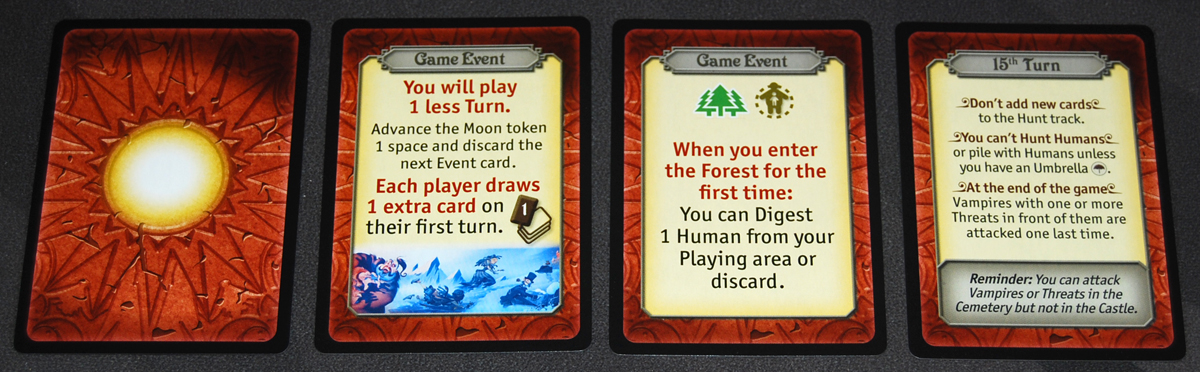
During setup, you draw one game event card—this is something that affects the entire game and stays in play.
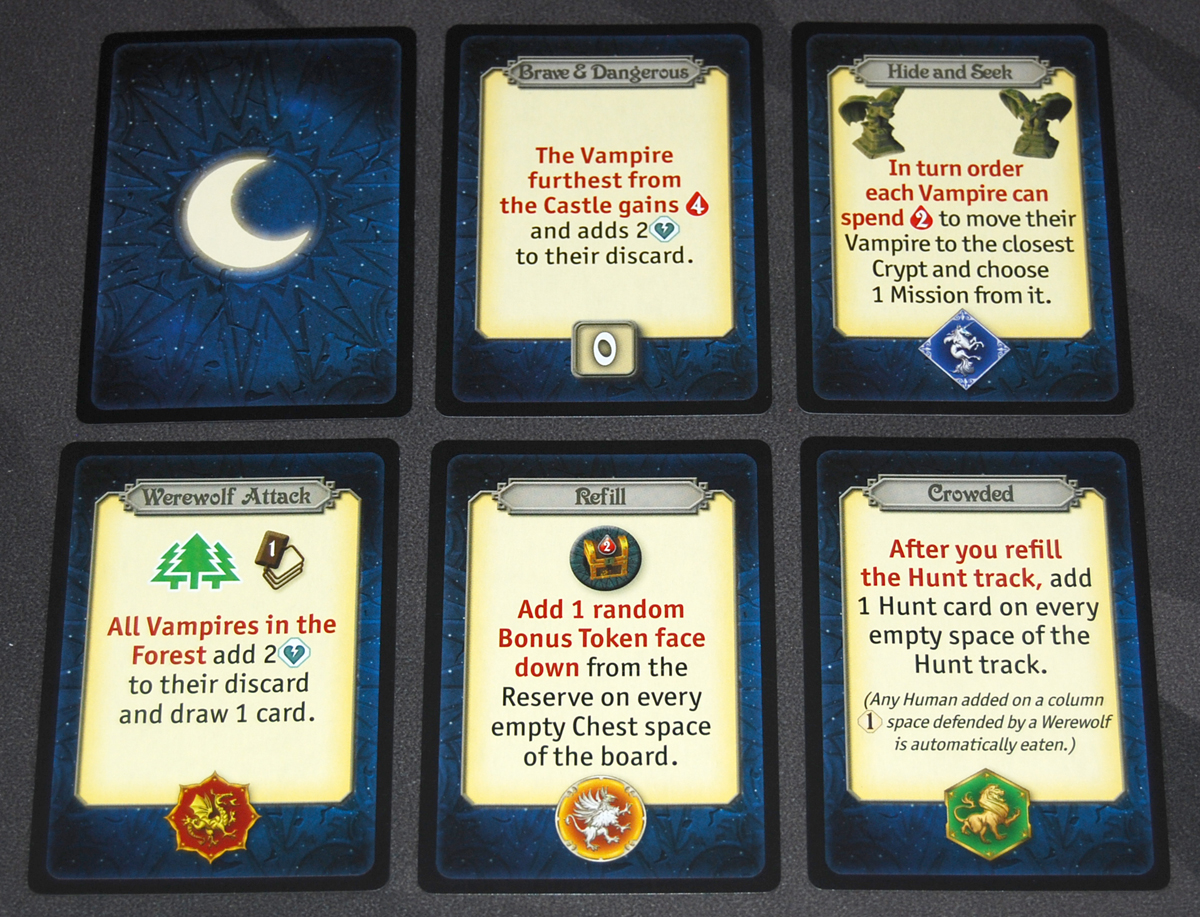
Starting in round two, you’ll flip the next event card in the stack, which has a one-time effect. The colored icon at the bottom indicates a potential threat that will spawn. “0” means no threat, but those cards are much less common!
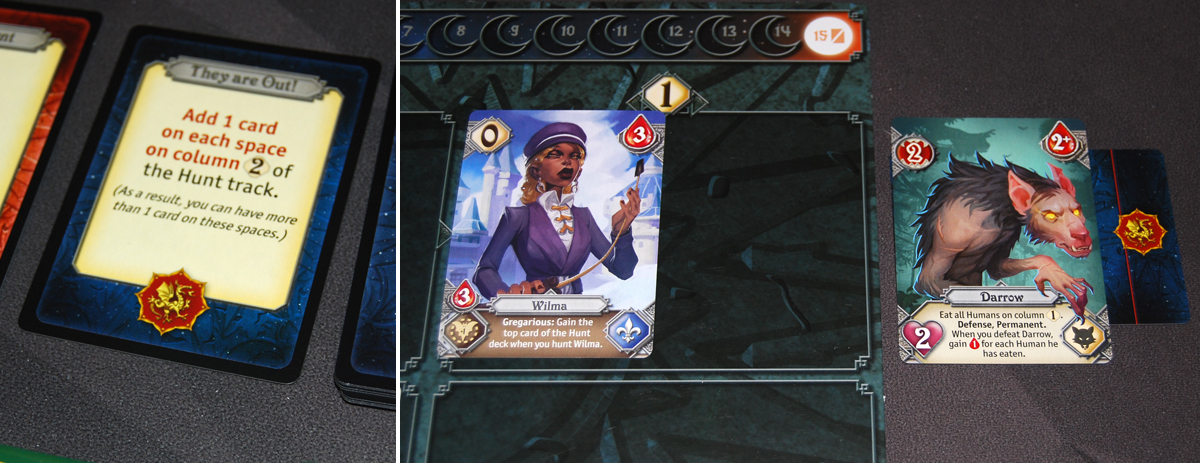
Check the available spawn location cards below the hunt track. If there is a card that matches the event card, the player with the lowest score draws the next threat card from the deck, places it on the spawn location card, and then places that to the right of the hunt track, next to a row that doesn’t already have a threat. (If there isn’t a free card that matches the event, then no threat is spawned this turn.) If a werewolf is placed, it immediately eats any humans in the “1” column of that row, placing them under the werewolf card. Any time more humans are added to the 1 column of that row, they are immediately eaten. (Powers and familiars are not eaten.)
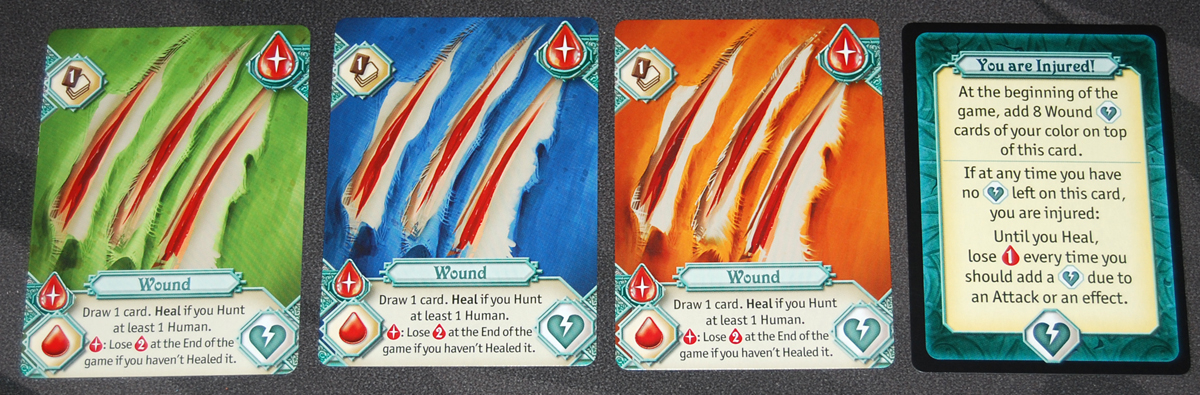
Whenever you hunt a card, if there is a threat next to that row, it attacks you. Place the threat card in your play area, where it will stay until you defeat it. (If it’s a werewolf, any humans it has eaten are moved with it in a stack.) Immediately add a number of wounds to your discard pile, based on the threat’s attack power. Every time you shuffle your deck, you add that many wounds again. If you run out of wounds (and your “You Are Injured” card is visible), then you lose points for each wound you would take. Wounds themselves let you draw a card—so they don’t make your hand worse—and you can heal if you hunt at least 1 human that turn, returning any wounds in your play area back to your wound pile. Note that wounds left in your deck at the end of the game will cost you 2 points each.
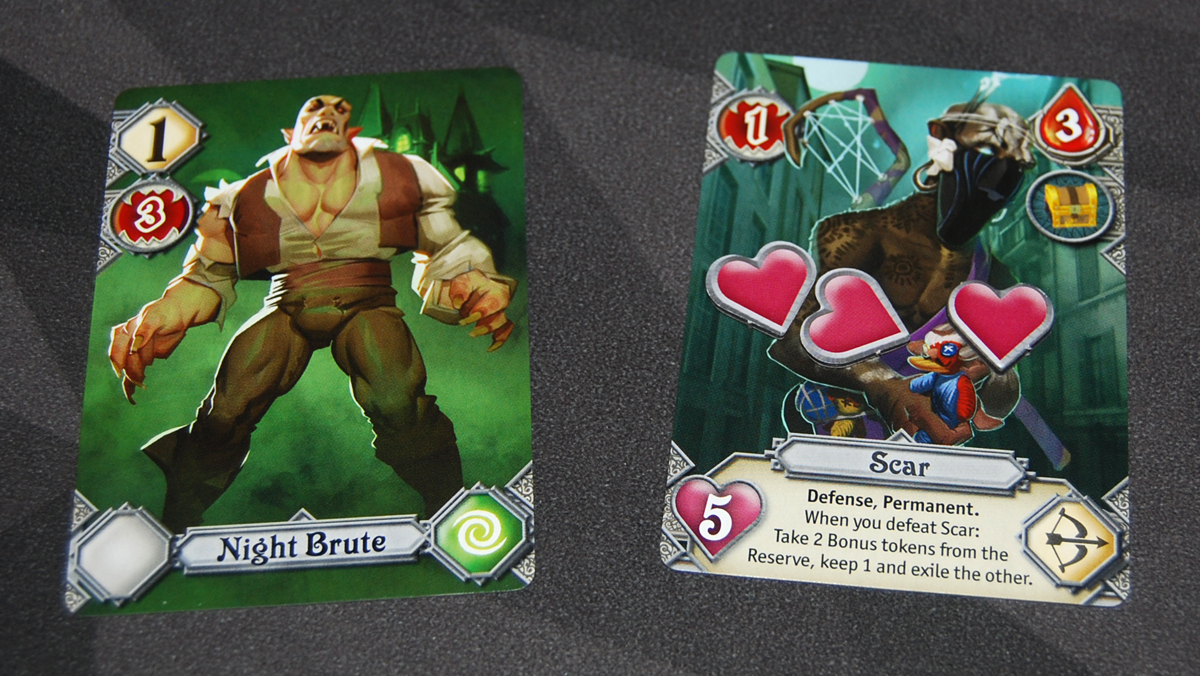
Many of the new vampire power cards have an attack value—the red circle with teeth. On your turn, you may use this attack power after you move in three ways:
- Spend attack power to add wounds to threats in your playing area.
- Add attack power to your unspent speed when hunting cards from the hunt track.
- Attack other vampires! If you end your other turn in the same space as another vampire, you may spend at least 1 attack to push a vampire 1 space in any direction, and then they discard 1 card from their deck for each attack value you spend. For each human discarded, you gain 2 points.
Once you have damaged a threat equal to its health (lower left), you have defeated it. Score the point value for the threat and place it in your digest pile. Vampire hunters have a bonus reward when you defeat them. If you defeat a werewolf, any humans it has eaten are also placed in your digest pile—while you don’t score the points for those humans, they may still count toward missions at the end of the game.
New Effects
Here are some of the new effects on bonus tokens, cards, and missions.

There are two new types of bonus tokens—one that gives you attack power, and one that gives you healing.
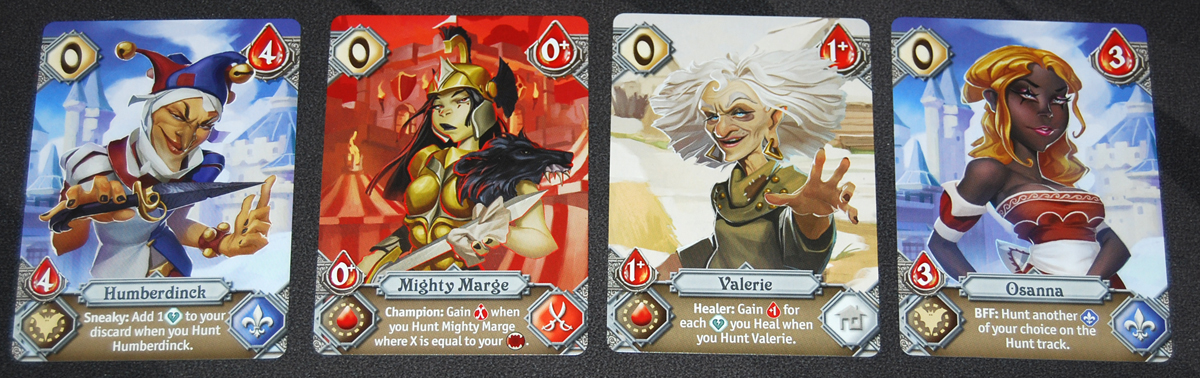
There are a few new keywords on the human cards:
- Sneaky: Add a wound to your discard when you hunt this human.
- Champion: Get points equal to your total attack power for the turn when you hunt this human.
- Healer: Gain point for each wound you heal when you hunt this human.
- BFF: Hunt another card (of a specified type) on the hunt track for no cost when you hunt this human.
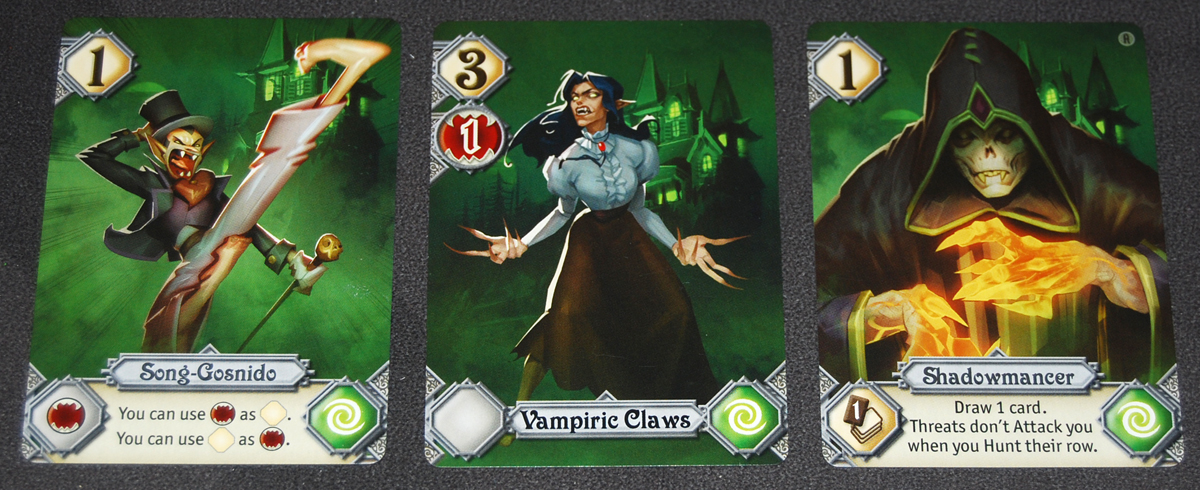
Most of the new vampire power cards have to do with attack power. Song-Gosnido lets you use your speed and attack power interchangeably for that turn, and Shadowmancer lets you ignore threats for that turn when you hunt.
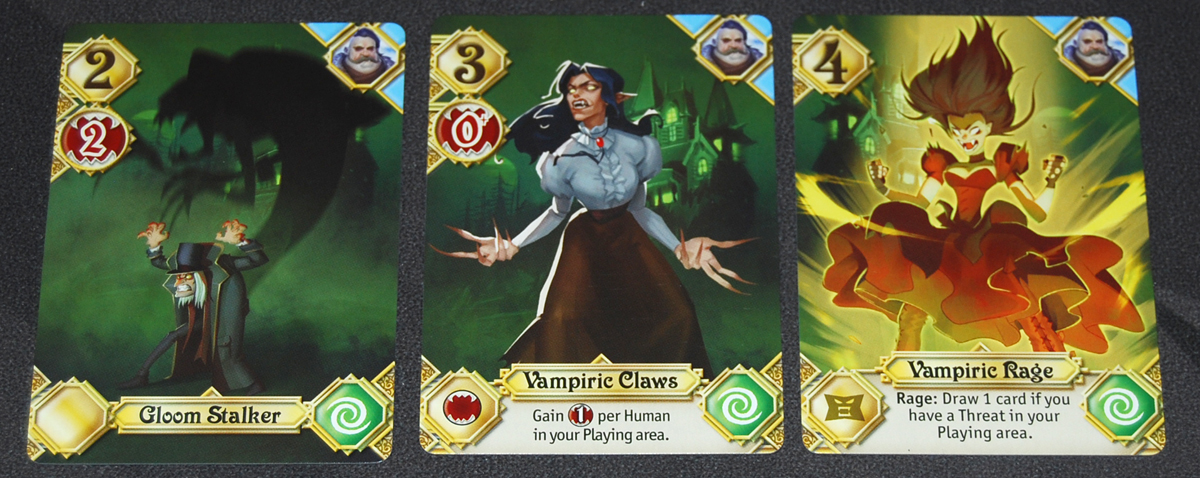
There is some overlap with the original starting cards, but the new cards add some attack, as well as the new effect “Vampiric Rage”: this one allows you to draw an extra card if you have a threat in your playing area.
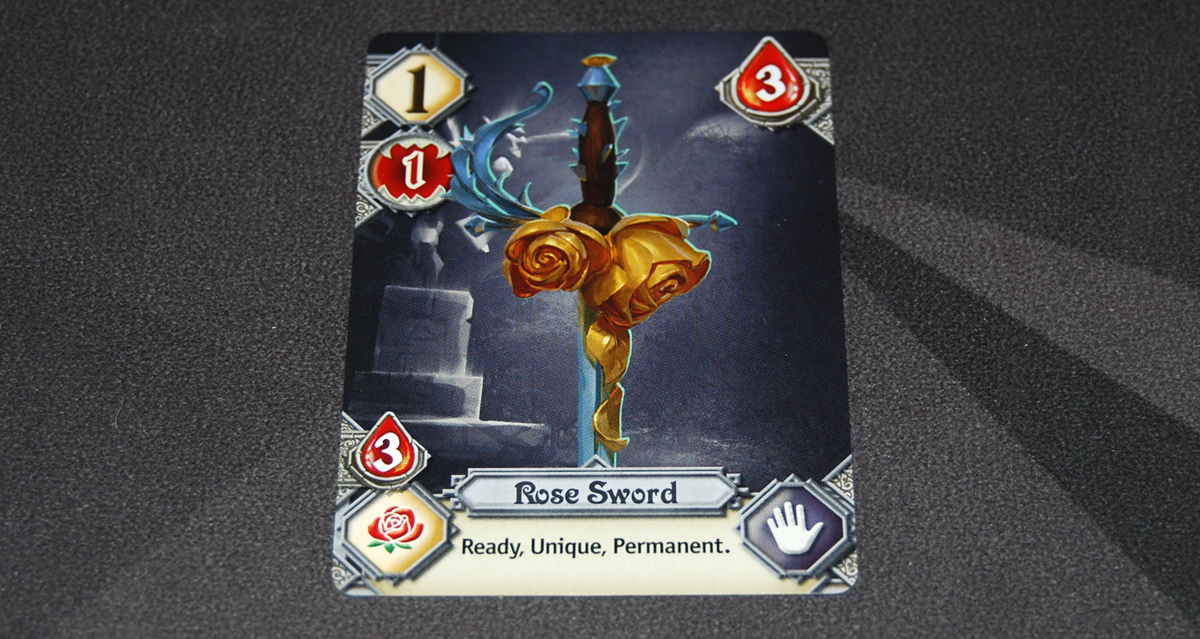
One new rose card has been added to the labyrinth—the Rose Sword. This one is worth 3 points and gives you 1 attack power every turn once you have it.
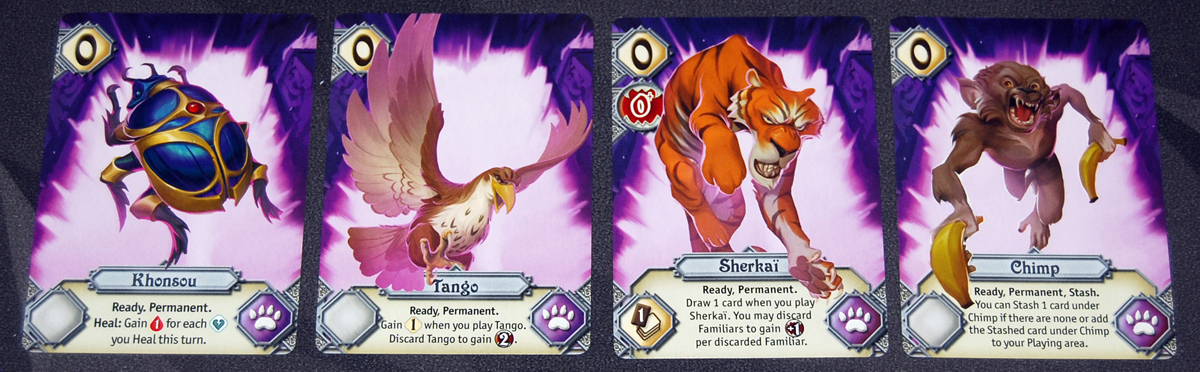
Most of the new familiars have effects associated with attack power or healing. The monkey has a “stash” ability, letting you store one card with it that can be played on a future turn.
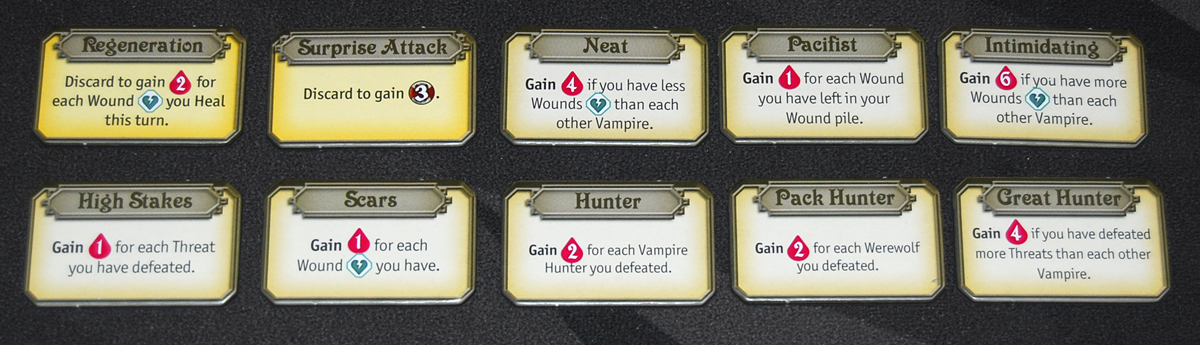
The new mission tiles incorporate the new gameplay effects—you can score points for hunting threats, or for getting (or avoiding) wounds. The rules point out that between the bonuses awarded by vampire hunters and the humans you gain by defeating werewolves, it is possible for players to earn more than 10 points on mission tiles, so that’s something to watch for!
Game End
If you have any undefeated threats when you enter the castle or when the game ends, they attack you one last time and then leave—you don’t score points for them or gain any bonuses. Scoring is the same as in the base game, but you also lose 2 points for each wound that you didn’t return to your wound pile.
Why You Should Play The Hunger: High Stakes
I always have a bit of trouble trying to time my reviews to particular seasons or events. Last year I had meant to get The Hunger written up in time for our Halloween games list, but failed, so I wrote up the review afterward. I received a copy of High Stakes in November, and after a few plays I thought to myself, hey, this would be good to write up for Halloween next year! And you see where that went. Well, here I am, just under the wire for our (somewhat later than usual) Halloween games list.
When I wrote up the base game last year, I drew the comparison to the tiny press-your-luck game Deep Sea Adventure, one of my personal favorites. The Hunger has some similar themes—greed vs. safety—but with a lot more moving parts, and a good dose of vampire-inspired humor.
High Stakes continues that trend. Even the title itself is indicative of its half-serious take on the theme: yes, the stakes are higher and, yes, raised stakes generally don’t end well for vampires. Now you’re not just after the mostly helpless humans—there are vampire hunters after you, and hungry werewolves chowing down on your dinner. (This is why you should always label your lunches, folks.)
It’s all about bigger risks and bigger rewards. If a werewolf sits there for long enough, eventually it accumulates enough humans that it’s probably worth the risk of wounds. Remember, you don’t get the points for the humans themselves, but if they’re of a type that you need for a mission, it can be a good way to collect a whole stack of humans without having to hunt them each down individually. Defeating a vampire hunter will get you either a bonus token or a mission tile, which can both be quite valuable depending on the circumstances.
The addition of the threats does make things more complicated and gives you more options to think about. You can still try to make a run for the labyrinth at the end of the track (that shiny new rose sword is pretty appealing!), and there are cards that can help you move faster, but it’s still not an easy task to get back home. Taking on threats can be worth a lot of points, but you have to watch your wounds—if you don’t heal enough, you’ll start bleeding out your score, and that’s pretty painful.
Since the base game of The Hunger already has quite a few moving parts, I do think the recommendation not to start off with High Stakes for your first game makes sense; it’s just a lot of different rules to learn at once if you’re new to the game. However, once you’re familiar with the base game, I don’t think the expansion adds too many things to keep track of, just a little more overhead. As I mentioned before, I do wish the expansion contents were marked so it would be easier to swap them in and out, depending on whether I’m teaching new players or just want to play the simpler version, but for the most part, I will probably leave the expansion mixed in from now on.
For more information about The Hunger: High Stakes, visit the Renegade Games site!
Click here to see all our tabletop game reviews.
 To subscribe to GeekDad’s tabletop gaming coverage, please copy this link and add it to your RSS reader.
Disclosure: GeekDad received a copy of this game for review purposes.

Click through to read all of “‘The Hunger: High Stakes’ — Bigger Risks, Bigger Rewards” at GeekDad.If you value content from GeekDad, please support us via Patreon or use this link to shop at Amazon. Thanks!


