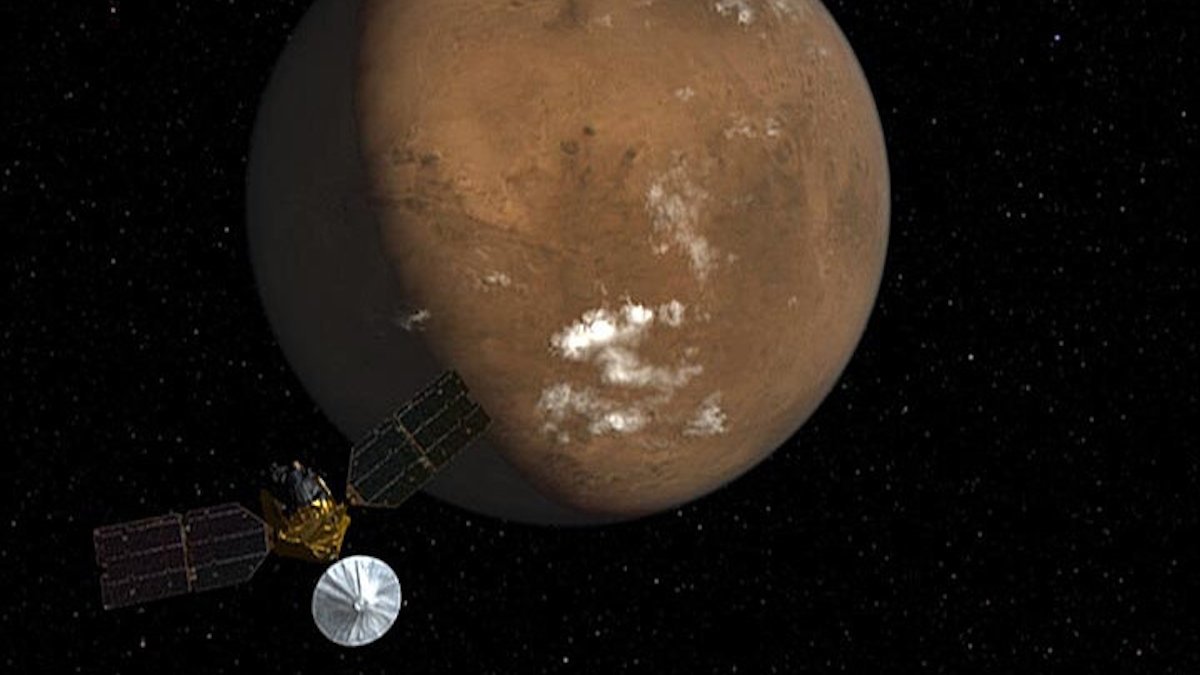
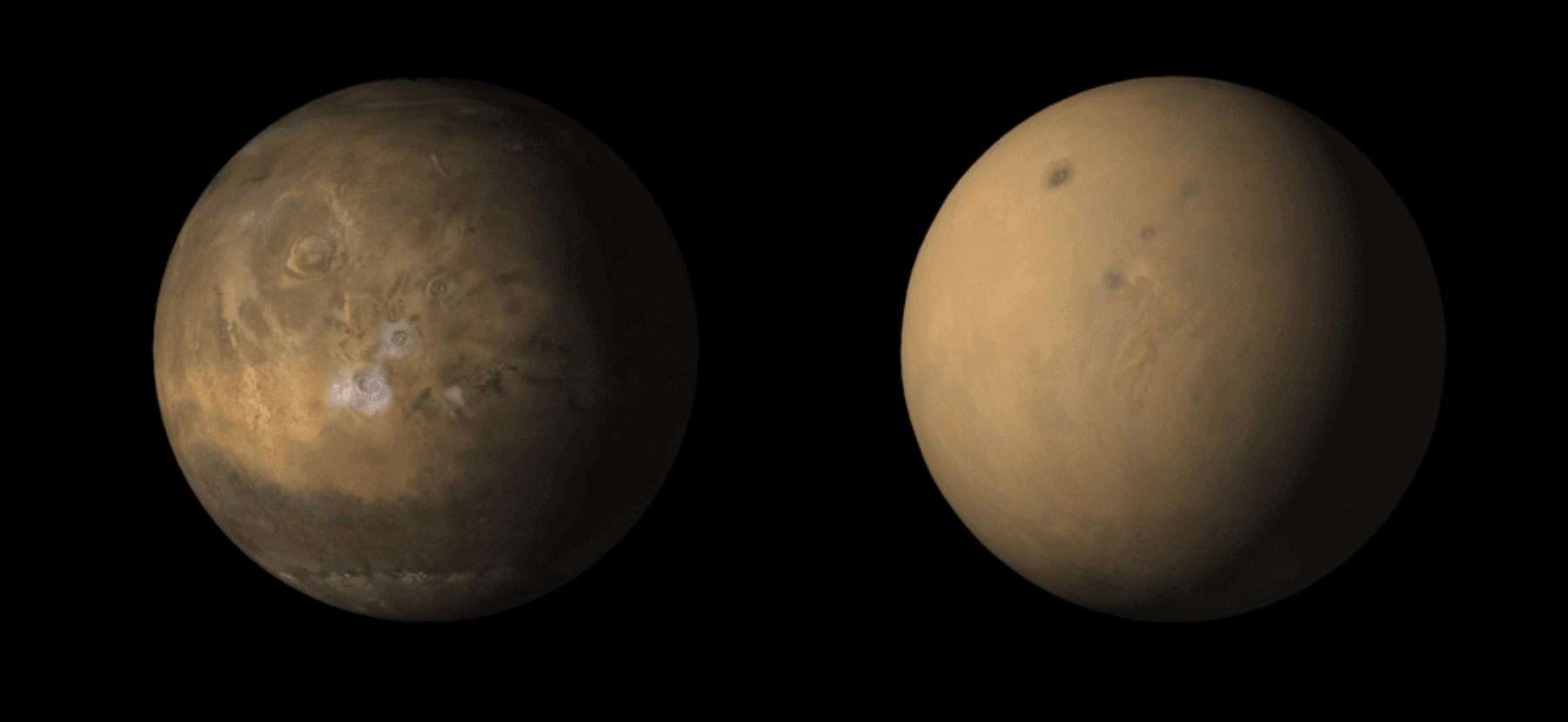
Image: NASA/JPL/Caltech
One thing that has fascinated people about Mars since we’ve first been able to view it through telescopes has been the existence of “canalis,” as astronomer Giovanni Shiaparelli called them in 1890. Lines criss-cross the surface of the planet, and Shiaparelli hypothesized they were water systems—a reasonable assumption. I mean, that’s just like what we have here on Earth. Percival Lowell, an astronomer from Boston, MA, heard the word “canalis,” and translated it as CANALS, instead of the proper meaning, CHANNELS (canals are dug by artificial means, and channels are natural occurrences), and got really excited. There must be civilization on Mars! He was so excited that he searched for a perfect place to build an observatory so he could study Mars when it was next at its position closest to Earth. He chose Flagstaff, AZ, and built Lowell Observatory on top of Mars Hill, where it still stands today.
Alas, there are no civilizations on Mars, and we haven’t found any signs of macroscopic life at all. But there ARE signs of naturally occurring channels and rivulets and ancient fluid flow on the red planet. One of the big mysteries of Mars is where did all of this fluid—and we assume, with some scientific evidence, it was water—go?
Last year (2018), scientists used NASA’s Jet Propulsion Laboratory’s Mars Reconnaissance Orbiter (MRO) to observe giant dust storms on the planet. The MRO has special equipment on board that can measure dust levels and “see” through the haze of dust storms to observe what’s going on on the planet’s surface below the storms. They observed several occurrences of what are called dust towers. These are huge columns of dust that are denser and go much higher into the atmosphere than normal dust storm activity. When Mars has a global dust storm, as happened last year, these giant towers, which can be as wide as Nevada, get constantly renewed with energy and material, and last for a long time. Some were seen to last about 3.5 weeks.
Now, when these towers form, they bring material from the planet’s surface up into the atmosphere. The longer and larger they are, the higher they can bring that material. During a global dust storm in 2007, scientists saw that the towers could bring small amounts of water molecules up into the upper atmosphere. When the water was up there, solar radiation hit it and caused it to break down into tiny particles that get whisked off into space.
Could this be what caused the majority of Mars’s water to disappear? Scientists can’t be sure yet. We don’t know what causes the giant dust storms on Mars. We’ve only been able to study a few of them, and we don’t have anything on Earth to compare this to. But if these dust towers happened billions of years ago, it could explain what happened to the lakes and rivers we see evidence of on the planet’s surface. Over the course of billions of years and many global storms, the water could have just been stripped away.
Scientists are hoping to use the instruments on the Mars Reconnaissance Orbiter to continue their studies of dust storms and water. Maybe someday we will solve this mystery and understand Mars—and Earth—better.
For more information, check out NASA’s Jet Propulsion Laboratory’s MRO mission page
This post was last modified on January 10, 2020 12:32 pm
Bring springtime and color into your home with Marimekko stationery items.
The fight between winter and the onset of spring is something we know well in…
Out today is the newest Mouse Guard book, 'Mouse Guard: Dawn of the Black Axe'—and…
If you like some extra squares in your cubes, check out the new Rubik's x…
Like many others, I jumped directly into my Apple Music Replay this year filled with…